The Buildout Gets a Single Buyer
The last edition tracked a buildout that held together under a seventy-two-hour war scare. This period the volatility moved off the battlefield and into the org chart, and the change is more durable than a missile exchange.

Powerus Signal · Week of July 6, 2026
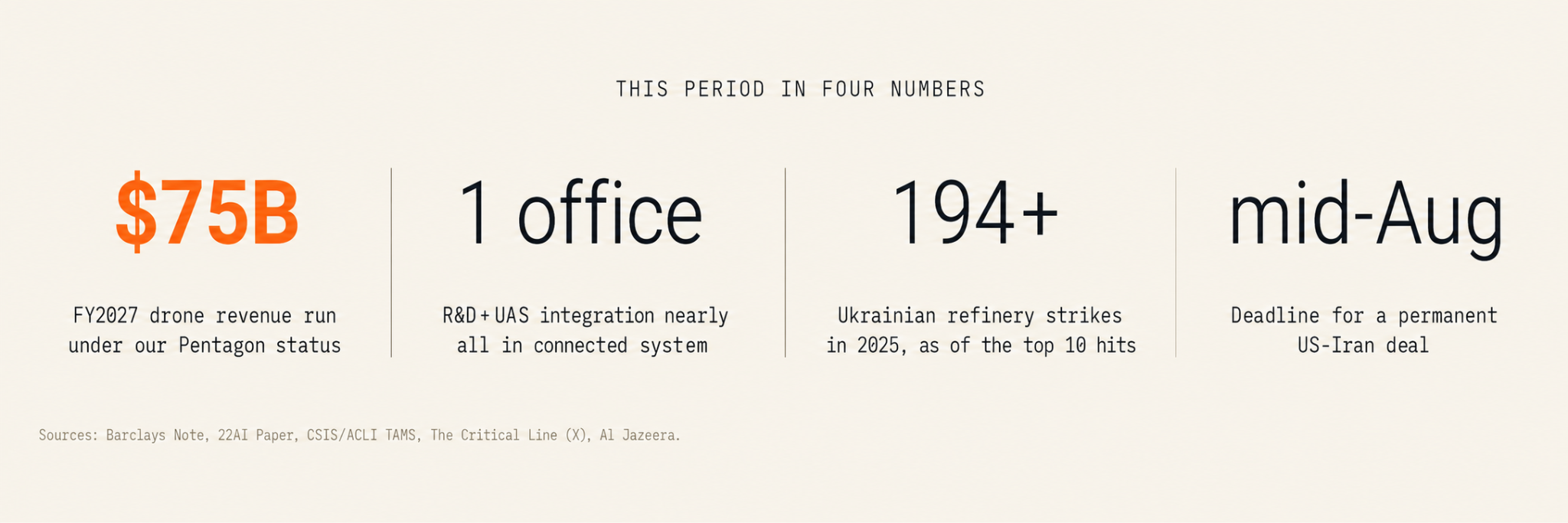
Sources: new Pentagon drone office and $75B request (Defense News, July 2026); scope of the DRPM-UxS memo (USNI News); 194 refinery strikes in 2026 (Ukrainska Pravda, citing the Financial Times); mid-August deal deadline (The Straits Times).
US drone buying used to run through the services’ own program offices. As of a June 29 memo, most of it runs through one. Nobody has the full list yet: the memo gives the new director ninety days to produce it. When a single Pentagon office can accelerate, reprioritize, or halt most unmanned programs, the contest for the rest of the decade is no longer about which company wins a demonstration. It is about which companies that office chooses to keep buying from.
The last edition tracked a buildout that held together under a seventy-two-hour war scare. This period the volatility moved off the battlefield and into the org chart, and the change is more durable than a missile exchange. The Pentagon consolidated nearly every unmanned-systems program under a new office backed by a $75 billion request. The Gulf ceasefire held, but the peace turned technical and stalled on a single question about the Strait of Hormuz. Ukraine’s refinery campaign hit a verified record pace.
The structural read is unchanged and sharper. The domestic drone industrial base is the durable trend, and Washington has now handed it a single owner. A buyer that used to speak through the services’ own program offices now speaks through one, and the firms already inside the Drone Dominance and Blue-list pipeline gain a clearer path while everyone else faces one gatekeeper instead of many.
This briefing covers the office that now owns US drone acquisition, what one buyer means for the parts base, the peace that turned into a standoff, the refinery war that became an economic weapon, and the defense bill still waiting on the Senate.
The Pentagon Names One Owner for Drones
A June 29 memo created a single office with the authority to accelerate, reprioritize, or cancel nearly every unmanned program in the Department.
In the period’s most consequential move, Defense Secretary Pete Hegseth ordered the creation of the Direct Reporting Portfolio Manager for Unmanned Systems, described in the memo as the single joint integrator for all unmanned and autonomous system programs across the Department. The office will oversee small one-way attack drones, drone boats and undersea vehicles, ground robots, swarming technology, counter-drone systems, and the Department’s drone marketplaces.
Its director, not yet named, will report to Deputy Secretary Stephen Feinberg and will act as the milestone decision authority for its programs, taking precedence on drone acquisition behind only the Secretary and his deputy.
One office, nearly all the programs. Sources: USNI News; Defense News (July 2026).
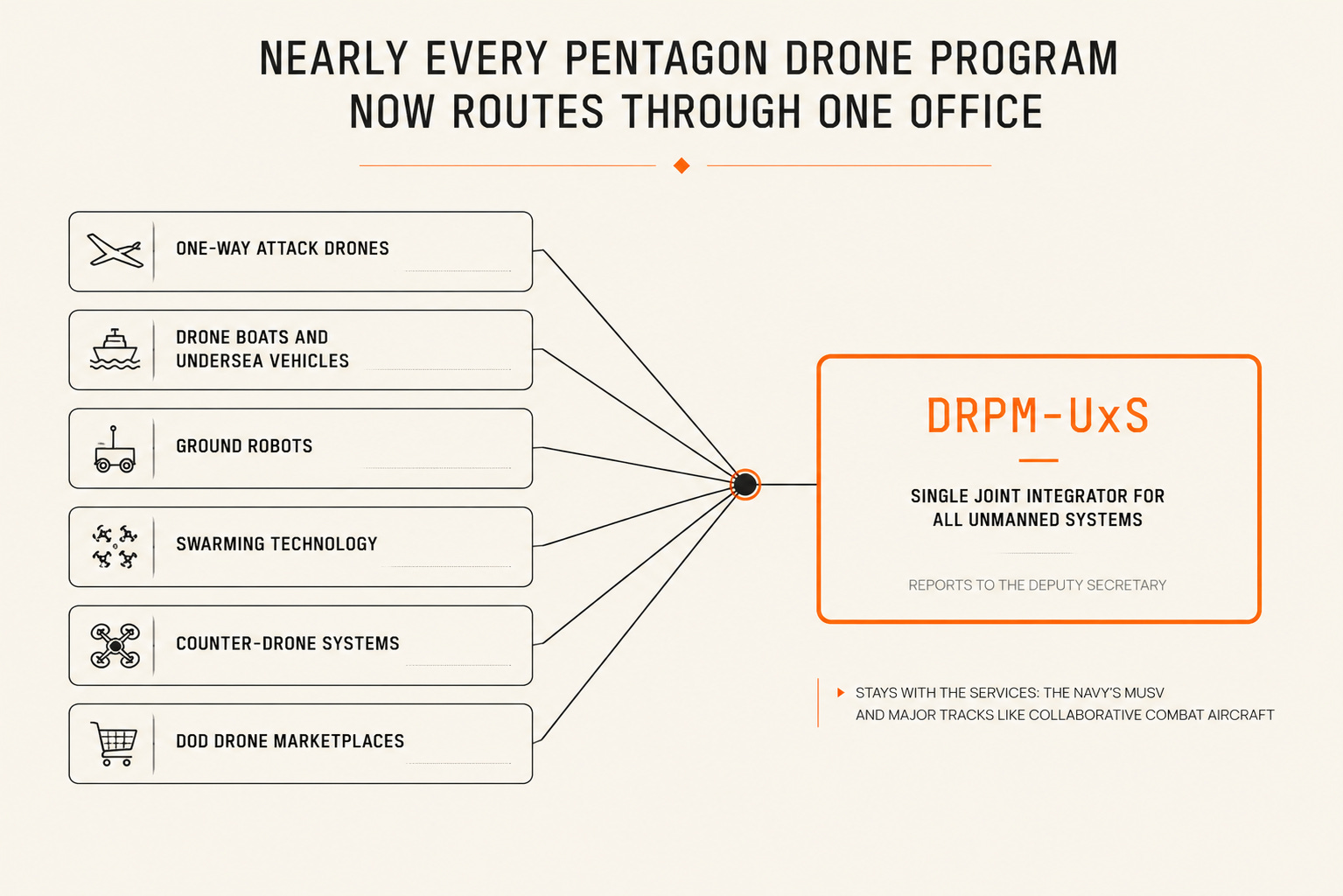
The consolidation is not total, and the exceptions matter. The Navy’s Medium Unmanned Surface Vessel stays with the service, as do major tracks already in their own acquisition lanes such as the Air Force’s Collaborative Combat Aircraft. The office’s programs, people, and jobs were also exempted from the Department’s hiring freezes and personnel cuts. That exemption is the tell that the office is meant to expand the drone portfolio, not simply reorganize it.
A single buyer moves faster than the offices it replaced, and it also concentrates the risk. The same authority that can push a program to scale in one decision can cancel one just as fast, and that is the new fact every supplier now has to plan around.
What One Buyer Means for the Base
A single gatekeeper rewards firms already inside the domestic, NDAA-compliant pipeline, and the capital is still wiring that base into place.
Behind the office sits the money. The FY2027 request asks for $75 billion for drones and counter-drone technology, with $54.6 billion of it going to the Defense Autonomous Warfare Group, the successor to the Replicator initiative. Most of the request sits in that one line, which means the office and its largest program are pointed at the same goal: buying low-cost autonomous systems at high volume, made from a domestic supply chain.
Most of the request sits in one line. Source: Defense News, FY2027 budget request (July 2026).
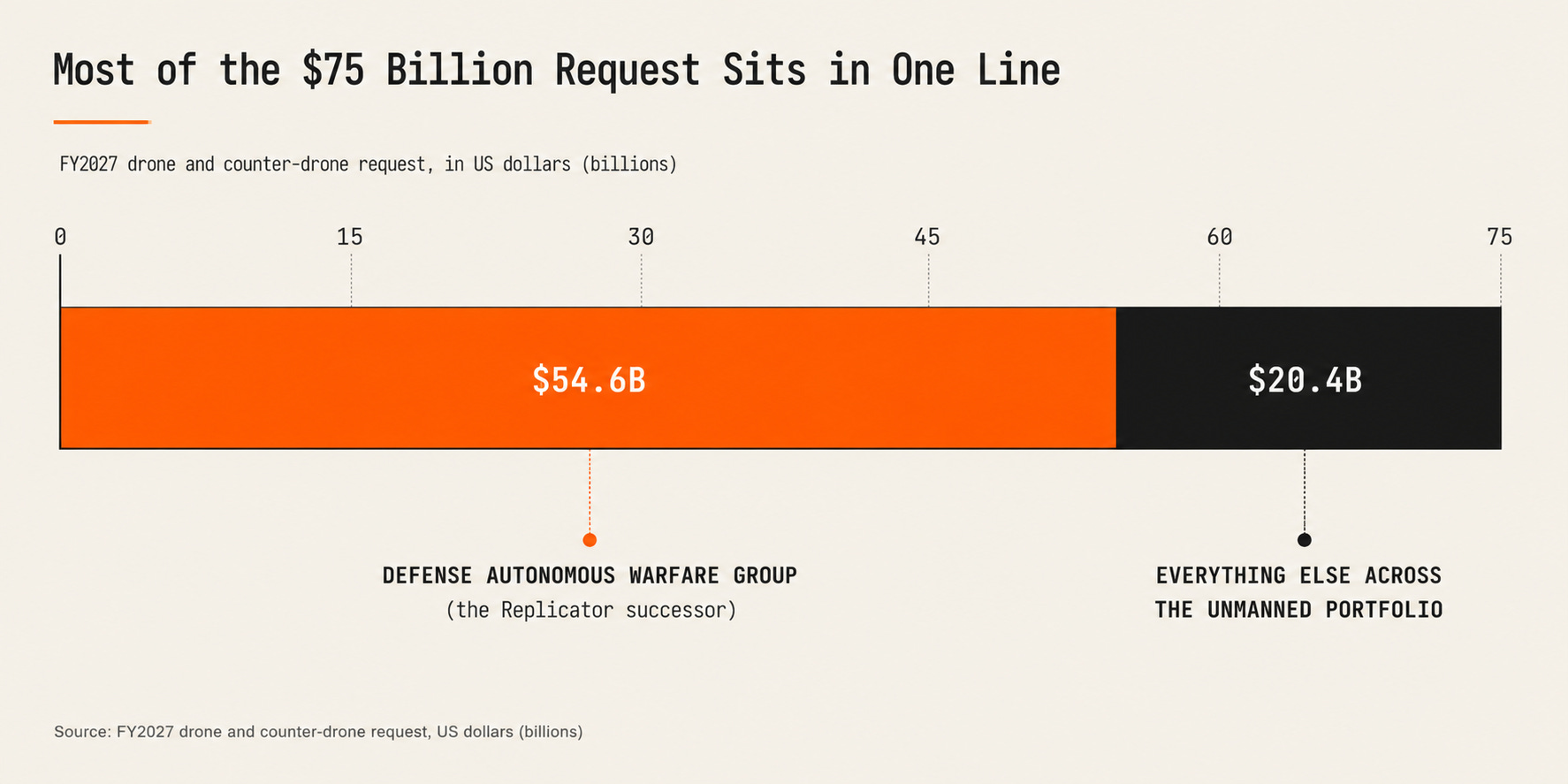
The read for domestic manufacturers is that being inside the pipeline is now the whole game. A single office deciding which drones scale rewards the firms that can already prove a clean, all-American parts trail, and the private capital is still moving to build that capability.
Unusual Machines, a US, NDAA-compliant component maker, signed a lease for roughly 14,000 square feet of manufacturing space in Orlando to support its battery business and is pressing toward a $52 million acquisition of Upgrade Energy, a domestic maker of battery and power systems for unmanned aircraft, expected to close by mid-third-quarter. The same company holds a supply relationship with Powerus, one of the domestic drone manufacturers this parts base is meant to supply.
A consolidated buyer does not change the constraint the last several editions have named. It sharpens it. The units still have to be built and sourced from parts that clear the rule, and now they also have to clear one office to reach scale.
Peace Turns Technical
The ceasefire held, but the talks stalled on who controls the Strait of Hormuz, and a state funeral paused the diplomacy with a mid-August clock running.
The Gulf moved from shooting to stalemate. With the guns quiet after the late-June flare-up, US and Iranian delegations met indirectly in Doha on June 30 and July 1 through Qatari and Pakistani mediators, and the sessions produced what Qatar called positive progress on the fourteen-point memorandum. The United States put the release of roughly $6 billion in frozen Iranian assets on the table. The nuclear file was never seriously taken up, and the negotiators left Doha as Tehran paused diplomacy for the funeral of supreme leader Ali Khamenei, buried July 9.
One clock, one open question. Sources: Al Jazeera; The Straits Times; Le Monde (July 2026).
The sticking point is sovereignty over the strait. Iran insists it has the right, with Oman, to manage traffic and levy tolls once the interim toll-free window expires, while Washington holds that the waterway is international and must stay unimpeded. The memorandum signed June 17 extended the ceasefire sixty days, which sets the deadline for a permanent deal in mid-August. Vessels have resumed transiting Hormuz but below pre-war levels, with Iran still issuing routing warnings and some ships hugging the Omani coast.
A holding ceasefire trims the immediate Gulf risk premium, but the toll dispute means every tanker transit and every routing warning is a potential headline. The demand for affordable interception outlasts the terms of any single deal.
The Refinery War Becomes an Economic Weapon
Ukraine ran its 2026 refinery campaign at about eleven times the prior year’s pace, turning long-range autonomy into a strategic instrument against an entire economy.
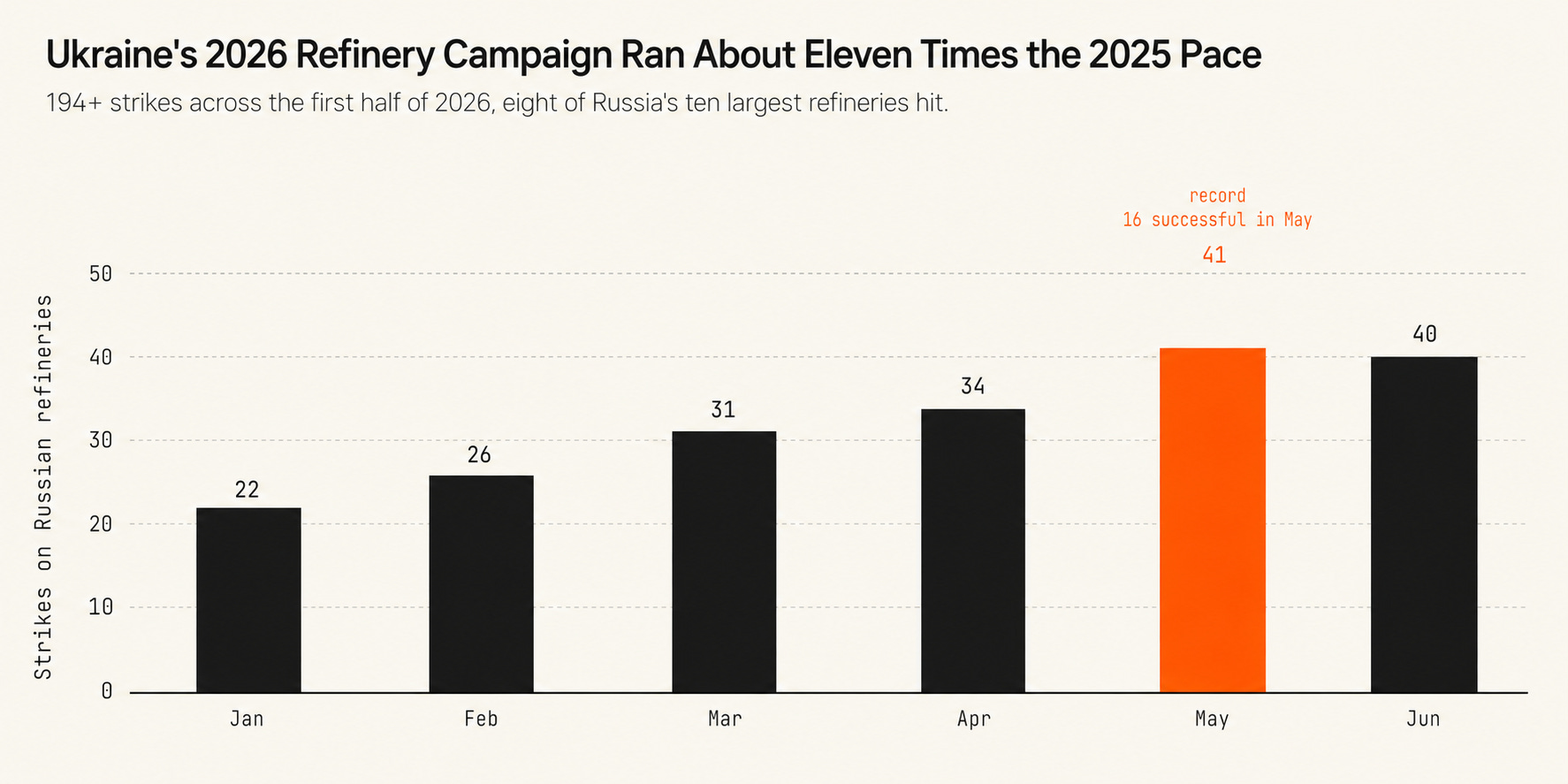
The eastern front escalated into a full economic-interdiction campaign. The Financial Times reported that Ukrainian drones have now struck eight of Russia’s ten largest refineries, with at least 194 strikes on Russian refineries across the first half of 2026, roughly eleven times the prior year’s pace, and a record sixteen successful strikes in May alone. In the reporting period Ukrainian forces hit the Lukoil refinery at Kstovo in the Nizhny Novgorod region and a plant at Yaroslavl, and touched off fires from Crimea to Yaroslavl, reaching the last refineries still supplying Moscow.
The record pace behind the fuel crisis. Source: Financial Times, via Ukrainska Pravda and RBC-Ukraine (2026). Monthly split illustrative around the reported total and May record.

Analysts quoted by the Financial Times describe an evolution from narrow oil-infrastructure targeting into a broad campaign hitting energy, logistics, industry, and exports at once, enabled by mass-produced long-range drones, better command and control, and US intelligence support. Russia is enduring its worst fuel shortages in decades, with more than forty regions rationing sales. The doctrine being written in the east is the one the Pentagon’s new office is buying against: mass autonomy as a strategic, economy-wide weapon, answered by affordable interception at home.
The Bill Stalls on the House Floor
A voter-identification fight froze the defense authorization before it could clear the House, and that procedural jam is the near-term risk to the timeline.
The defense bill lost ground in the period, and the reason had nothing to do with defense. A plan by House leadership to tie the FY2027 authorization to a voter-identification measure, the SAVE America Act, collapsed on the floor when fourteen Republicans joined Democrats to block the rule 198 to 224, freezing House business for a second straight week and sending the chamber into its July 4 recess early.
The Senate version, running to about $1.1 trillion, still awaits floor action of its own. The direction of the bill is not in dispute. The schedule for getting it through the House and into conference before the August recess is now the open variable.
What to Watch (July 6 to 13)
Four near-term events. Each tests whether the consolidated structure can convert authority into fielded capability.
Who leads the new drone office. The DRPM-UxS director has not been named. Watch for the appointment and any early guidance on priorities, since this office now shapes the entire US drone procurement pipeline. The choice signals which programs accelerate and which marketplaces survive.
The next Doha round and the mid-August clock. With the Khamenei funeral behind it, watch for the next round of US-Iran talks to be scheduled at the earliest opportunity. The tells are any movement on the Strait of Hormuz toll question and the $6 billion asset release, the two gating issues before a permanent deal, with mid-August as the hard deadline.
The NDAA after the recess. With the House rule frozen by the voter-identification standoff and the chamber out until after July 4, watch for a second attempt to bring the authorization to the floor, Senate action on its roughly $1.1 trillion version, and the start of a House-Senate conference before the August recess.
The domestic battery close. Watch for the Unusual Machines acquisition of Upgrade Energy to close by mid-third-quarter, and for any further domestic-sourcing moves as the contracting rules keep tightening around foreign-made hardware.
Each is measurable and near-term, and none depends on a single company. Together they describe how steadily the United States can turn one consolidated buyer and a domestic supply base into capability in the field.
Bottom Line: One Door, One Question
The period’s lasting change was structural. A single office now owns US drone acquisition, and the winners are whoever can stay inside it and build at scale.
This was the period the buildout got a single buyer. The Pentagon put nearly every unmanned program under one office with a $75 billion request behind it. The Gulf ceasefire held but the peace turned technical, stalling on a Strait of Hormuz toll dispute with a mid-August deadline now the clock everyone is watching. Ukraine’s refinery war peaked into an economy-wide campaign. The risks are concrete, a stalled Gulf deal above all, but the direction is not in question.
Both wars keep teaching one lesson in two languages: cheap mass on offense, affordable interception on defense, and the side that can manufacture at volume from a domestic base wins the exchange. Consolidation does not change that lesson. It changes who decides. The winners for the rest of the decade are the firms that can field at scale, from an all-American line, and clear the single office that now stands between a program and a purchase order.
A single office can now accelerate or kill nearly any US drone program in one decision. Does one consolidated buyer speed the domestic base toward scale, or does it narrow the field to whoever is already inside the tent? Reply with your read.
Powerus builds autonomous systems for defense, counter-UAS, agriculture, wildfire response, and maritime operations. Designed, manufactured, and assembled in the United States.