Demand Is Proven. The Chair Is Empty.
The June ceasefire between Washington and Tehran collapsed into live fire. After Iran was accused of attacking three commercial ships in the Strait of Hormuz, the US struck around 90 targets across Iran, Iran answered against US bases in three countries and downed an MQ-9, and by July 8 President Trump had declared the ceasefire over.

Powerus Signal · Week of July 13, 2026
Sources: NBC News, The National, Forbes.
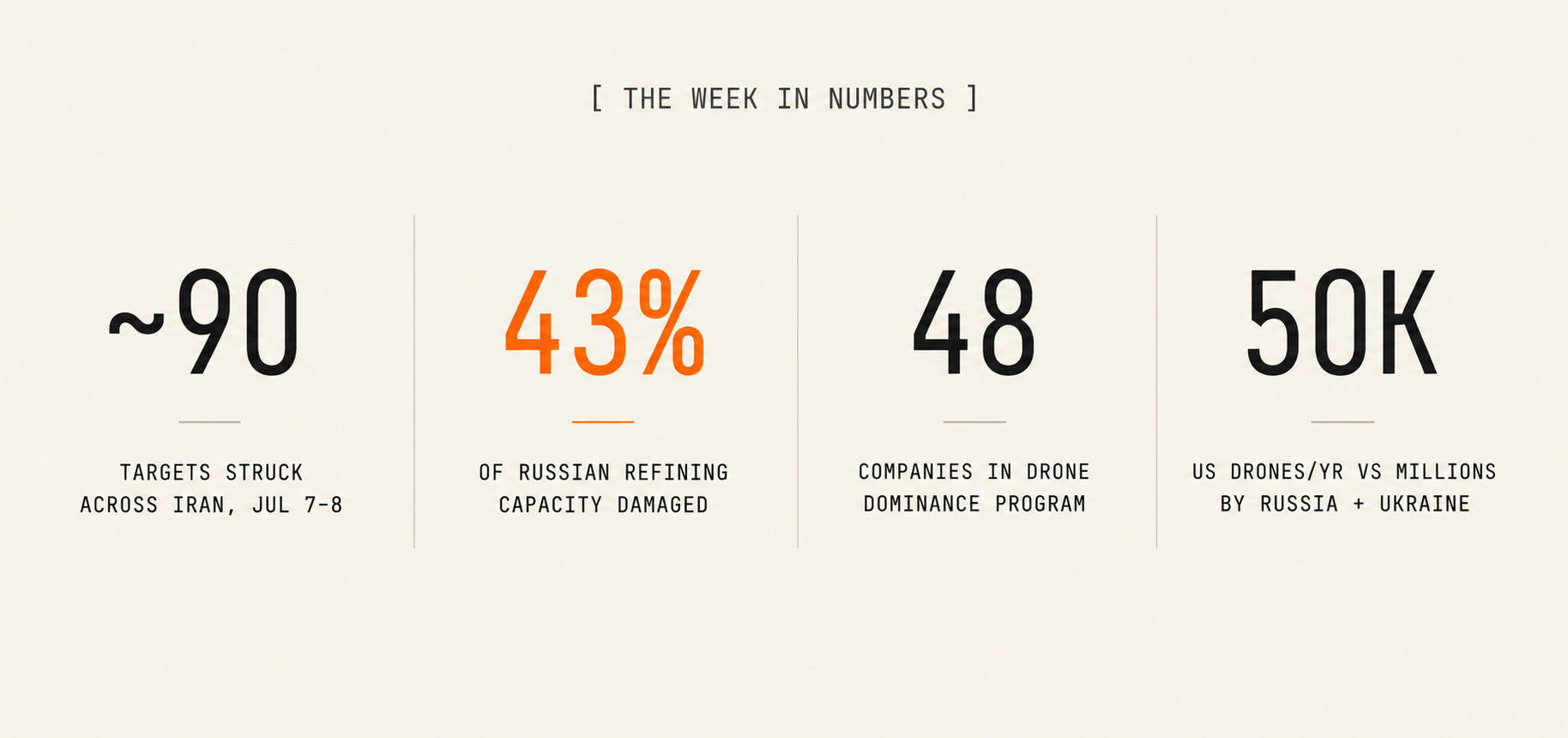
Industrial-scale drone demand is now a matter of public record on two fronts. The bottleneck is no longer proof. It is the empty chair at the Pentagon’s new buying desk.
The June ceasefire between Washington and Tehran collapsed into live fire. After Iran was accused of attacking three commercial ships in the Strait of Hormuz, the US struck around 90 targets across Iran, Iran answered against US bases in three countries and downed an MQ-9, and by July 8 President Trump had declared the ceasefire over.
On the other front, Ukraine’s drone campaign crossed from tactic to industrial system. Strikes reached 21 vessels in three days, shuttered Russia’s largest refinery, and pushed the cumulative damage to 43 percent of Russia’s refining capacity, forcing Moscow to ban diesel exports through July 31.
The industry spent the same days building the response layer. Swarm software entered the Pentagon’s FPV competition, counter-drone training economics reached the creator audience that actually flies and fights, and fire-suppression drones moved closer to a real mission. The one thing that did not move: the Pentagon’s new consolidated drone office, created by a June 29 memo, still has no director.
The structural backdrop makes the stakes plain. The US produces perhaps 50,000 drones a year against the millions built annually by Russia and Ukraine, and the Pentagon’s answer runs through a 48-company competition chasing a $5,000 unit price. Closing a gap that wide is a procurement problem before it is a technology problem, which is why an unfilled director’s chair matters more than any single contract this period.
The Gulf Goes Back to Live Fire
The dispute over who controls the Strait of Hormuz is now being contested with strikes instead of talking points. The June truce, signed as a 60-day memorandum of understanding, came apart in the second week of July. Washington blamed Tehran for drone attacks on three commercial ships in the Strait. Over July 7 and 8, US aircraft hit around 90 targets across Iran. The Revolutionary Guard answered with missiles and drones against US installations in Bahrain, Kuwait, and Jordan, and shot down an American MQ-9. On July 8, Trump declared the ceasefire over while saying talks could continue.
How the truce unraveled, July 6 to 12. Sources: Time, Axios.
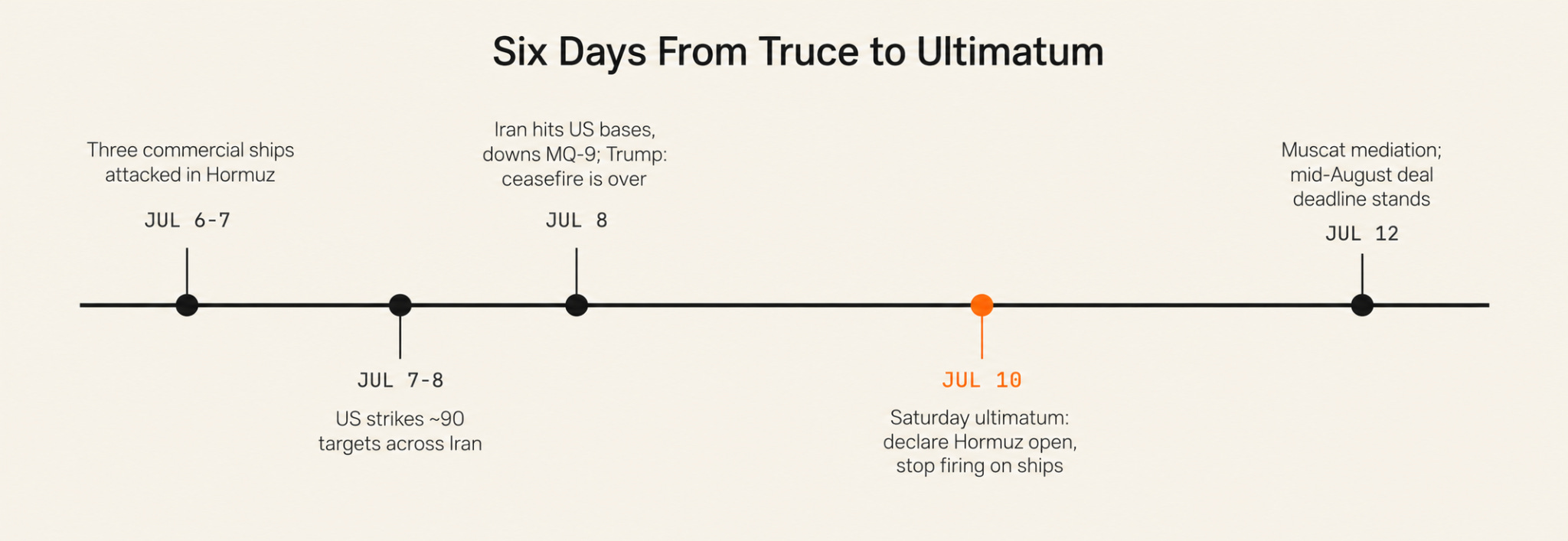
The week ended on an ultimatum. US officials gave Iran a Saturday deadline to state publicly that the Strait is open and that its forces will stop firing on commercial ships, with one official promising harsh consequences for refusal. Iran’s foreign minister was expected in Muscat for Omani mediation the same day. The underlying question is unchanged from the original memorandum: whether Iran can charge tolls on Hormuz transits after the 60-day toll-free window, against a mid-August deadline for a permanent deal.
Forty-Three Percent
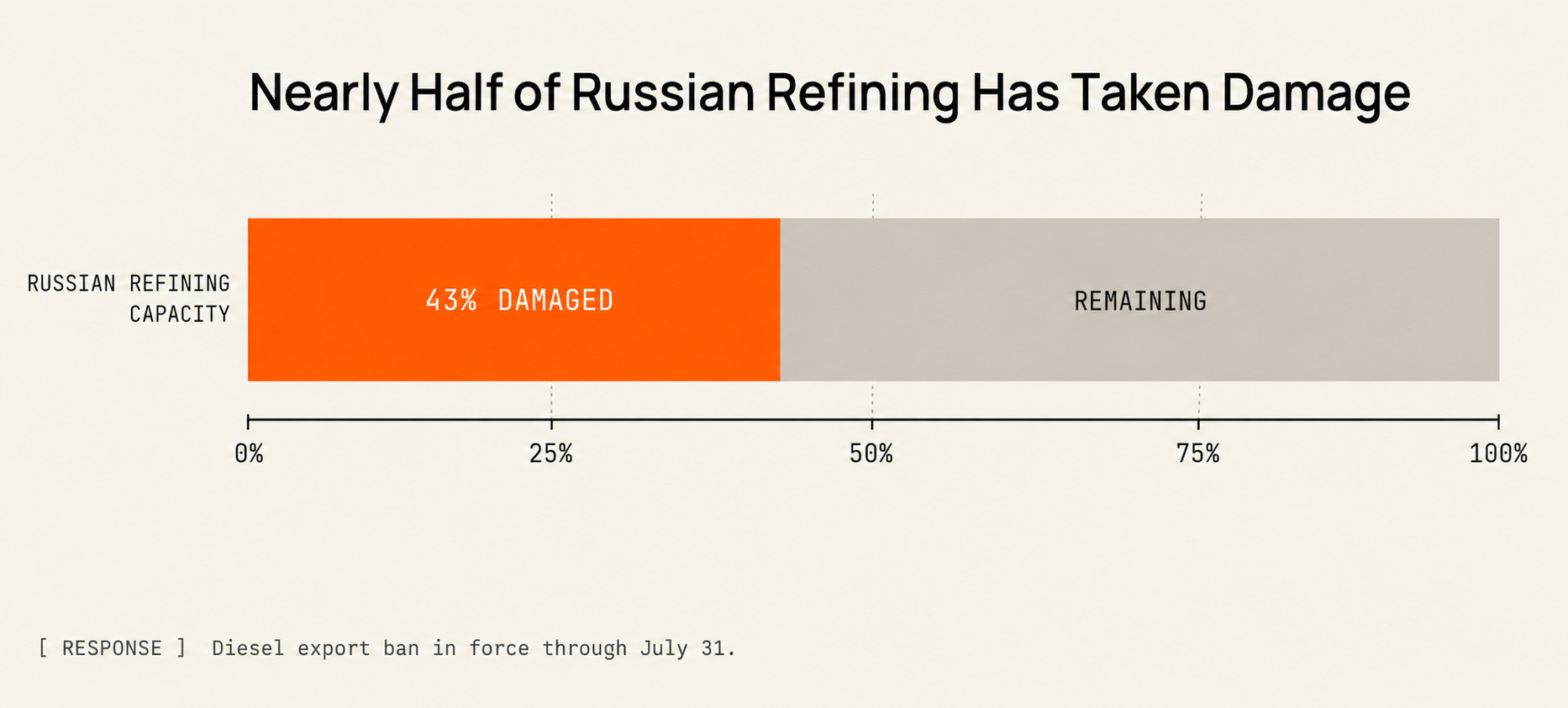
Ukraine’s refinery campaign now has a measurable industrial result: nearly half of Russia’s refining capacity has taken damage. Drones hit the Omsk refinery on July 6, Russia’s largest, and the 440,000-barrel-per-day plant halted operations the next day after fire damaged a crude unit that accounts for roughly 38 percent of its processing. In the same three days, Ukrainian drones struck 21 vessels, including nine in the Sea of Azov, and the commander of Ukraine’s Unmanned Systems Forces described the maritime effort as running at industrial scale.
The cumulative tally is the story. By early July the campaign had damaged 43 percent of Russia’s refining capacity, and Deputy Prime Minister Alexander Novak announced a diesel export ban through July 31 to protect domestic supply as shortages spread.
Cumulative damage to Russian refining capacity and the export-ban response. Sources: Kyiv Post, The National, OilPrice.
The alliance response arrived the same week. At the NATO summit in Ankara on July 8, Trump told President Zelensky the US would license Ukraine to produce Patriot interceptors, and the alliance pledged 70 billion euros for Ukraine. A war being fought with mass-produced drones is now also reshaping how the West licenses and localizes its own production.
Swarm Software Enters the Competition
The Pentagon’s FPV competition just gained its first battle-tested swarming layer, and it points at the pilot shortage nobody has solved. Forbes reported on July 1 that US drone builder Powerus has partnered with Swarmer, the maker of swarming software proven in Ukraine, for the Pentagon’s Drone Dominance Program. The program is trying to close a production gap the article states plainly: the US builds perhaps 50,000 drones a year against the millions produced annually by Russia and Ukraine, with a target price of $5,000 per FPV.
Swarmer’s software lets one operator control a set of reconnaissance and attack drones at once. The résumé behind it is short and unusual:
Founded in May 2023 as a US defense technology company with its engineering roots in Ukraine.
Proven across a reported 100,000 combat missions in the drone war.
Listed on Nasdaq in March 2026 after a debut that put Ukraine-born drone autonomy in front of US public markets.
Powerus is one of 48 companies in the competition; its president framed the logic as arithmetic rather than automation, telling Forbes that without swarm technology on every drone there will simply not be enough pilots.
The demand curve is set by wars that fly millions of drones a year. The constraint on the US answer is not airframes. It is operators, and software that multiplies them.
Counter-Drone Training Goes Creator-Native
Training against drones is becoming a volume business, and the audience that needs it watches creators, not trade press. Industry reporting in July described a cost-per-engagement training model built around reusable target drones, and the economics read like a range card rather than a brochure:
Modular airframes rated for 30 to 50 training iterations each, per the reporting.
A practical cost of roughly $40 per engagement after repairs.
Distribution through the military-content creators Garand Thumb and Drone Round, putting threat-representative targets in front of the practitioner audience that actually trains against them.
The precedent is already set at the Army’s marquee event. In April, the Best Ranger Competition integrated live drone threats for the first time, flying target drones against competitors. The signal for the base: counter-drone readiness is moving from an occasional range day toward a repeatable, priced-per-repetition discipline, and the distribution channel for that shift looks more like YouTube than a defense conference.
The Suppression Race
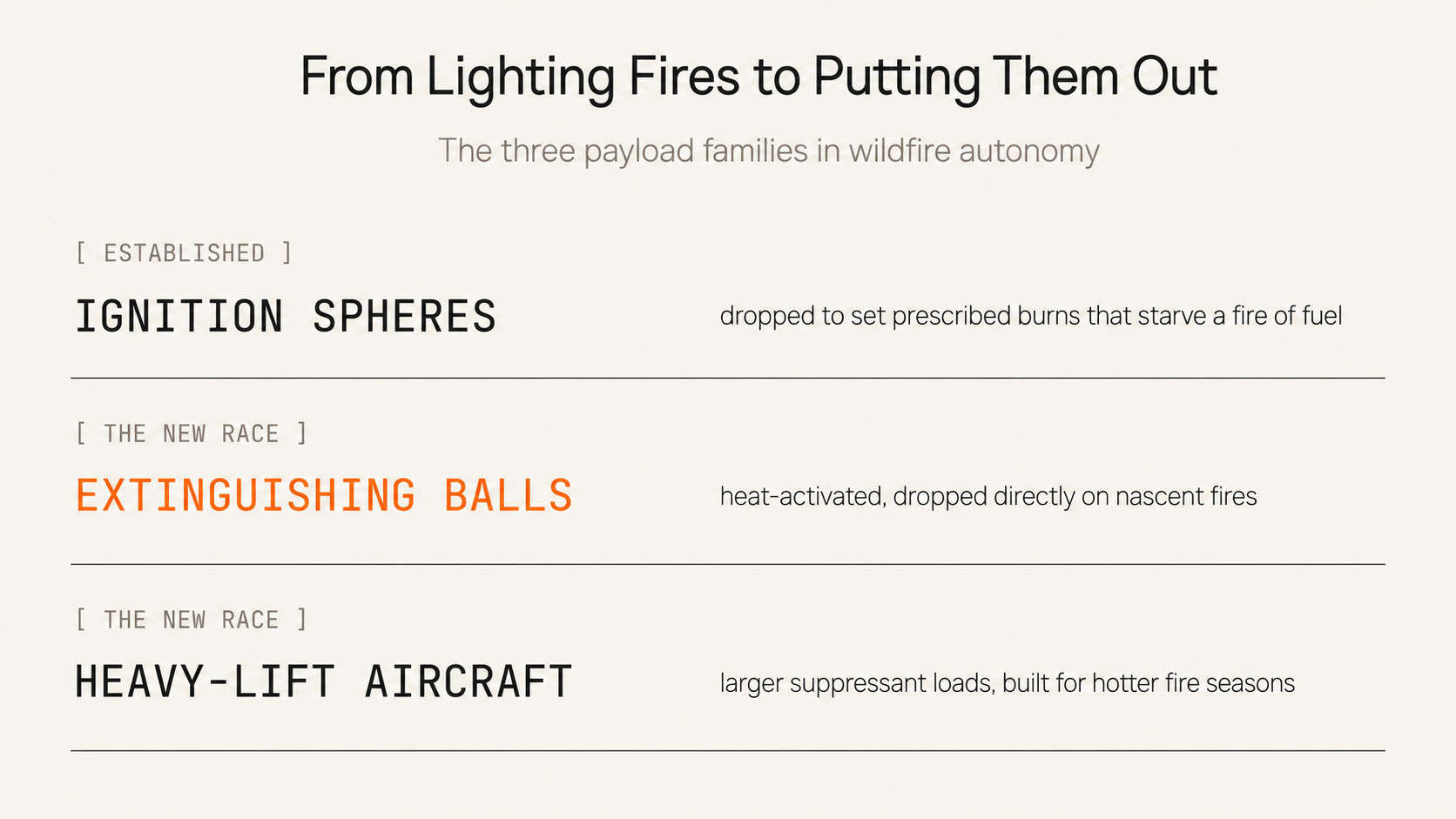
Fire-fighting drones are moving from lighting fires to putting them out. The established use case is ignition: drones dropping chemical spheres, known in the field as dragon eggs, to set prescribed burns that starve a wildfire of fuel. The new race runs the other direction, and the payloads sort into three families:
Heat-activated fire-extinguishing balls dropped directly on nascent fires.
Ignition spheres for prescribed burns and firebreak construction ahead of a fire line.
Larger suppression aircraft that a widening field of startups is building for hotter fire seasons.
The established mission is ignition. The race now is suppression. Sources: CNN, MDPI, NBC News.
The payload is the easy part. The hard problem sits upstream of it: spotting a fire across a wide, unlit, environmentally difficult area, routing an aircraft to it without a pilot, and getting mass on target before the fire outruns the response. A wildfire is decided in its first minutes, which rewards detection speed and delivered payload over platform pedigree. That is why the field chasing this mission looks less like traditional aerospace and more like the autonomy sector.
The through-line to defense is direct. Detect fast across a wide area, get an autonomous aircraft on target, deliver an effect in minutes, and the mission profile of wildfire suppression becomes the mission profile of base defense with a different payload. Firms that build for one are increasingly positioned for the other.
The Chair Is Still Empty
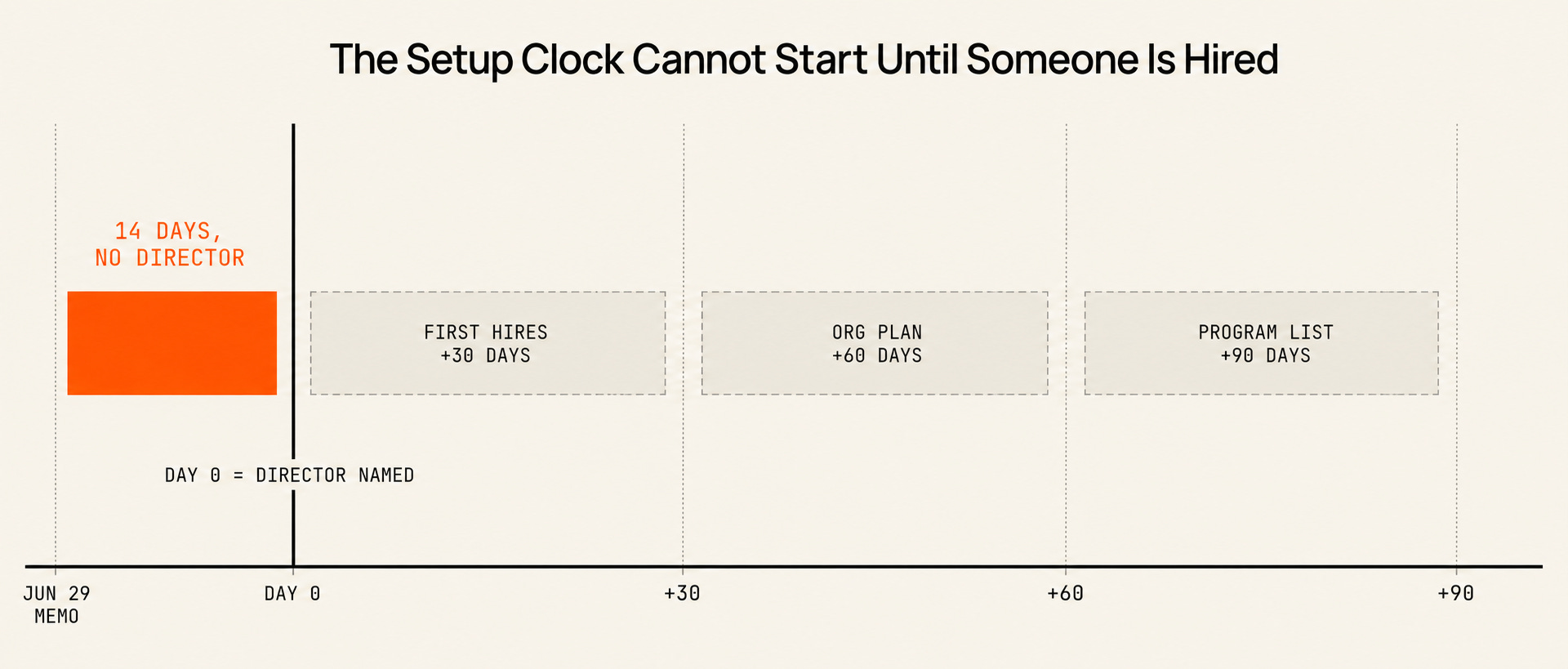
The office created to buy against all of this demand has now spent its first two weeks without a leader. The June 29 memo from Defense Secretary Pete Hegseth established the Direct Reporting Portfolio Manager for Unmanned Systems, a single office answering to Deputy Defense Secretary Stephen Feinberg with authority over how the military develops, buys, and fields unmanned systems across air, ground, and sea. It pulls authority from the services, and per reporting through the second week of July, no director has been named.
The memo’s own clock makes the vacancy consequential. The setup milestones run 30, 60, and 90 days from a named director, so every week without one pushes the entire consolidation timeline to the right while the demand signal from the Gulf and Ukraine gets louder.
The DRPM-UxS setup clock cannot start until a director is named. Source: USNI News.
A procurement consolidation is only as fast as its first hire. Until the chair is filled, the single buyer is a memo, not a market.
What to Watch (July 13 to 20)
Four events test whether the pressure converts into decisions.
Iran’s answer to the ultimatum. Whether Tehran issues the demanded public guarantee on Hormuz, and whether the Muscat channel produces a path back to the memorandum, against the mid-August permanent-deal deadline.
A name for DRPM-UxS. The first director appointment starts the 30/60/90-day clock and tells the base who actually owns the pipeline.
Senate movement on the defense bill. With the August recess approaching, the window to advance the FY2027 authorization and its drone provisions is narrow.
The Western fire season. Whether the suppression aircraft now being built get flown against real fires as the season peaks, which is the test that matters more than any demonstration.
Bottom Line: Proof Arrived Before the Buyer
The period settled the demand question in public. A broken ceasefire put drones and counter-drone systems back at the center of the Gulf, and Ukraine’s campaign produced a measurable industrial outcome, 43 percent of an adversary’s refining capacity damaged by cheap airframes flown at scale. The US industry’s response layer is visibly assembling: battle-proven swarm software inside the Pentagon’s FPV competition, training priced per engagement and distributed through creators, and suppression drones learning to put fires out rather than start them. What has not assembled is the buyer. The office designed to convert all of this into orders remains leaderless, and until it has a name, the most important date in US drone procurement is still blank.
If the new drone office called you tomorrow, what should its first purchase order be: swarm software, training capacity, or production lines? Make the case in the comments.
Powerus builds autonomous systems for defense, counter-UAS, agriculture, wildfire response, and maritime operations. Designed, manufactured, and assembled in the United States.
LinkedIn Newsletter Settings (for posting, week of July 13)
SEO title: Counter-UAS News: Pentagon’s New Drone Office Has No Director
SEO description (151 characters): A broken ceasefire, 43% of Russian refining hit, and the Pentagon’s drone office still leaderless. This week in counter-UAS and DoD drone procurement.
Keyword basis (Semrush export, May 20, 2026): “counter uas” carries 1,300 searches a month and triggers Google’s AI Overview; “counter uas news” carries 210 searches a month at difficulty 7, which makes it the natural recurring anchor for a weekly news roundup; “dod drone” carries 90 searches a month at difficulty 33. The title and description are built around those three terms.