The Week Drones Got a Four-Star
The signal this period is institutional, not anecdotal. The Senate moved to stand up a four-star command built specifically to buy autonomous systems, the procurement money kept landing on contractors, and a list of barred Chinese suppliers turned ally-sourced manufacturing from a preference into a requirement.

Powerus Signal · Week of June 15, 2026
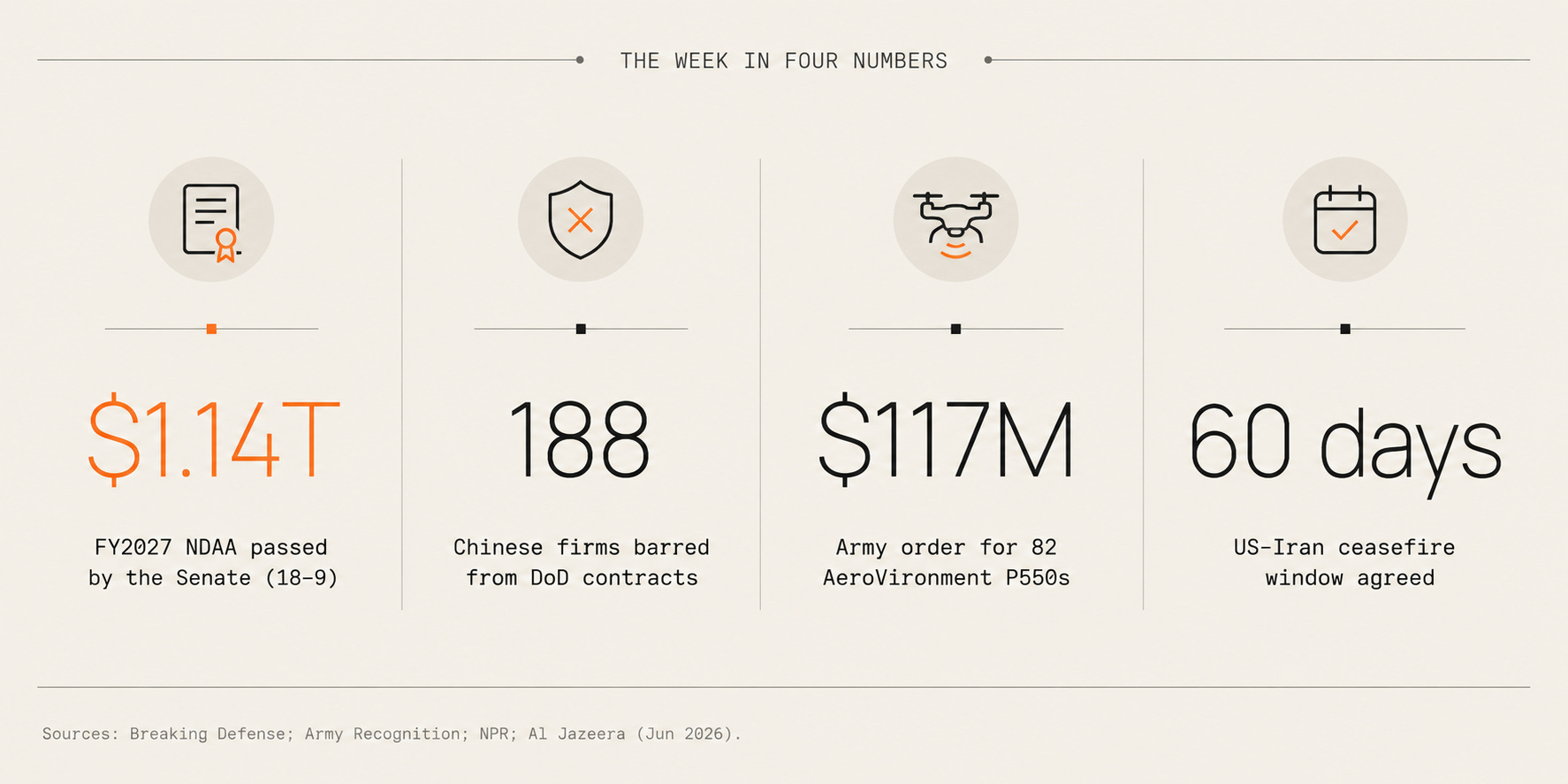
Sources: $1.14 trillion NDAA (Breaking Defense, June 2026); 188 Chinese firms designated (NPR); $117 million P550 order (Army Recognition); 60-day ceasefire (Al Jazeera).
The last edition tracked the surge becoming purchase orders. This edition tracks it becoming permanent structure. The Pentagon is building an institution to keep buying drones long after any one war ends.
The signal this period is institutional, not anecdotal. The Senate moved to stand up a four-star command built specifically to buy autonomous systems, the procurement money kept landing on contractors, and a list of barred Chinese suppliers turned ally-sourced manufacturing from a preference into a requirement. At the same time, the loudest near-term justification for the buildout started to cool: the United States and Iran agreed to a framework to end a hundred-day war and reopen the Strait of Hormuz.
The through-line is that demand is detaching from any single threat. A year of orders is now being wrapped in standing structure, a dedicated command, a multiyear authorization, and a procurement rulebook that favors domestic production. The companies that matter for the rest of the decade are the ones that can manufacture at scale, pass acceptance, and source their parts at home, whether or not a given war is ongoing.
This briefing covers what moved, why the structure matters more than the headlines, and the four near-term events that test how fast the system can field what it is now built to buy.
A Four-Star Command, Built to Buy
The Senate moved to create a four-star command for autonomous systems, with buying power from day one.
On June 11, the Senate Armed Services Committee passed its fiscal 2027 defense authorization by an 18 to 9 vote, advancing a roughly $1.14 trillion bill (about $1 trillion for the Defense Department and $41 billion for defense-related work at the Energy Department). The most consequential line is structural. The bill directs the Pentagon to establish a Robotic and Autonomous Systems Combatant Command, a four-star-led headquarters and the first new combatant command since Space Command was re-established in 2019.
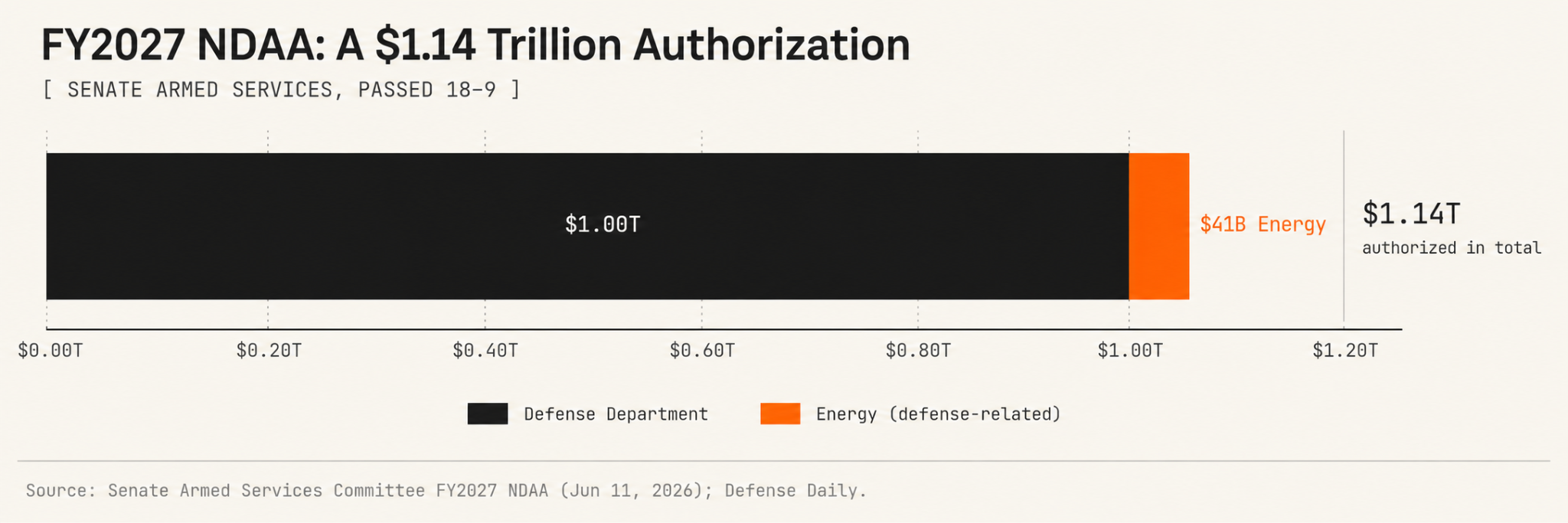
The Senate Armed Services Committee passed the bill 18 to 9 on June 11. Source: Senate Armed Services Committee FY2027 NDAA; Defense Daily.
What makes the command different is that it would hold acquisition power from inception. The provision gives it limited authority to experiment and buy directly from the commercial marketplace, along with test-and-evaluation functions and the job of getting autonomous systems into the hands of field commanders. It would not have to wait on the service branches to fund it. The idea was shaped by Ukraine’s stand-up of a drone-focused military service and by the delivery bottleneck the Army hit under Replicator, where autonomous systems were bought but not fielded fast enough.
The bill carries hardware authorities alongside the command. It authorizes multiyear procurement for the F-35 and F-15EX, contracts that can run as long as five years and that the Congressional Research Service estimates save 5 to 15 percent, and it sets a floor of no fewer than 1,800 fighter aircraft in the total inventory. Final enactment is not expected before the fall, after full Senate and House floor votes and a House-Senate conference.
A combatant command is a different kind of customer than a budget line. A budget line can be cut in a markup. A command with its own acquisition authority is a buyer that persists across budget cycles. That is what institutionalization looks like.
The Money Kept Moving
Procurement actions piled up alongside the policy, led by a fast Army order and a joint-force counter-drone approval.
The contracts did not wait on the authorization. The Army awarded AeroVironment a $117.3 million deal for 82 P550 long-range reconnaissance drones, with completion targeted for July 23, an unusually quick turn for a program of that size. It is one of three recent awards that show where the money is flowing.
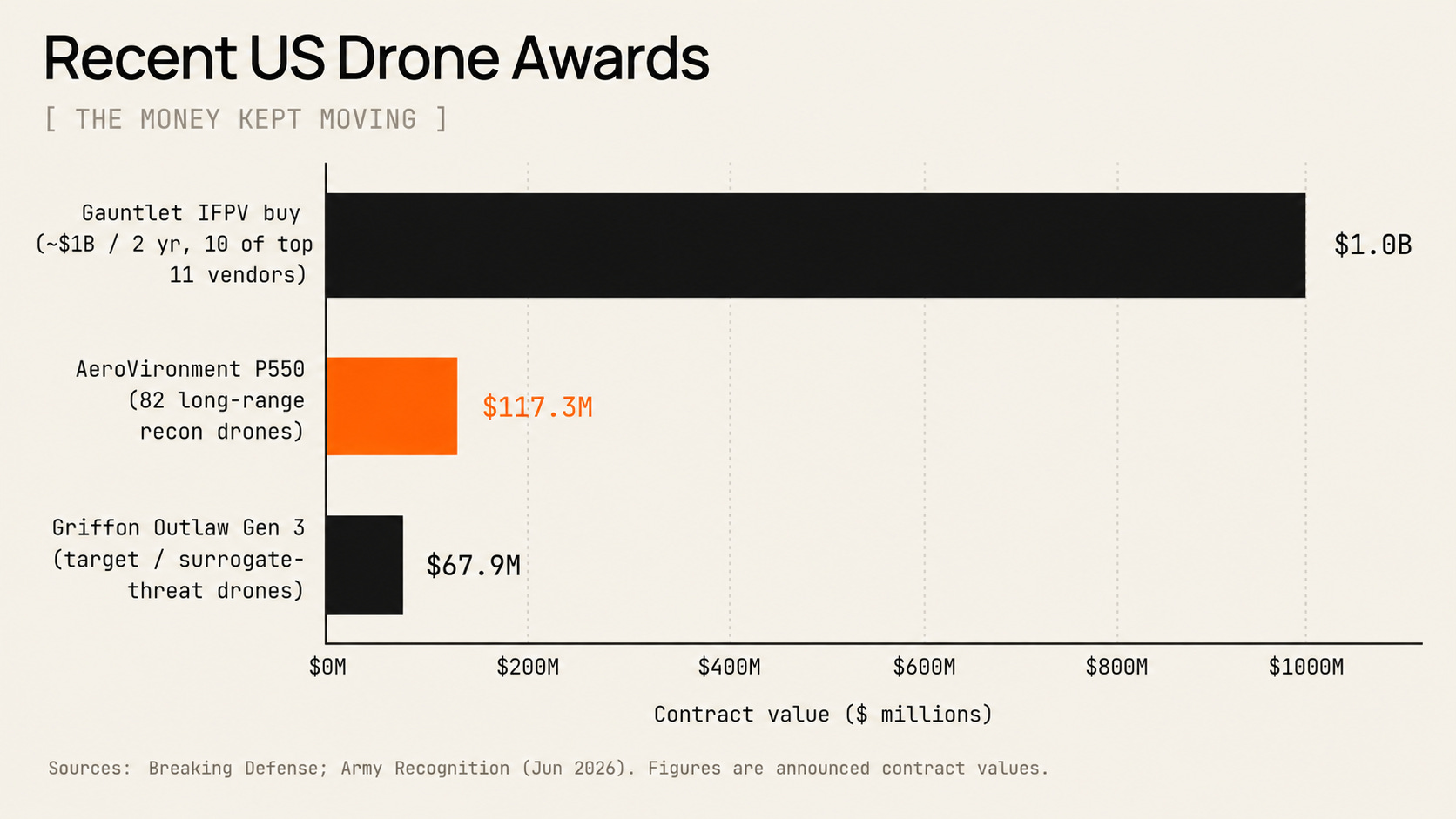
Announced contract values. Sources: Breaking Defense; Army Recognition (June 2026).
Two more signals landed on the counter-drone and program side. The Pentagon validated CACI’s SkyValor system for operational use across the joint force, a non-kinetic counter-drone capability cleared after border testing as part of a layered defense. And the department set the next phase of its Drone Dominance program for late 2026, keeping the production pipeline pointed forward. The pattern is consistent with the institutionalization read: the policy builds the buyer, and the awards keep the existing vendors moving while it does.
The China Ban Hardens Ally-Sourcing
Barring 188 Chinese firms turns domestic and allied manufacturing from a preference into a procurement rule.
On June 8, the Pentagon designated 188 Chinese companies as military entities, including Alibaba, Baidu, BYD, and Unitree Robotics. Under Section 805 of the fiscal 2024 defense authorization, a direct-contracting ban on the listed firms takes effect June 30, and the list grew from 134 entities to 188 in this update. A second tier covering indirect procurement through supply chains follows in mid-2027.
For domestic drone makers this is a tailwind, not a threat. It hardens the case for ally-sourced manufacturing and a parts supply chain that clears the procurement filter, the position that companies building United States and allied production, Powerus among them, have been moving toward. The structural effect is the same as the new command: it changes the default. Where a buyer might once have weighed the cheapest component, the rule now narrows the field to suppliers who can prove where their hardware comes from.
Two structural changes landed in the same period: a buyer built to keep buying, and a rule that defines who is allowed to sell. Together they reward domestic production capacity over the best prototype.
One War Winds Down
A framework deal cools the Gulf threat, but it is fragile and does not undo the lesson the war taught.
The week’s geopolitical headline was de-escalation. After a mid-period escalation in which United States forces struck Iranian radar sites and Iran fired drones and missiles at bases in the Gulf, Washington and Tehran agreed to a framework to end the war and reopen the Strait of Hormuz. The arrangement sets a 60-day ceasefire and a memorandum of understanding to be signed June 19 in Switzerland, with the naval blockade lifted and shipping through Hormuz resuming.
The read for the buildout is more durable than the deal itself. A ceasefire trims the near-term Gulf threat that has been the loudest argument for counter-drone spending. But the framework is fragile, with a 60-day clock and several issues left unresolved for a later round, and the war just demonstrated the exact problem the buildout targets: cheap drones overwhelming expensive defenses. Secretary of State Marco Rubio named that mismatch directly in earlier testimony, that the United States keeps using costly interceptors against cheap drones and that has to change. The structural demand for affordable interception persists.
One War Grinds On
The deep-strike drone war between Russia and Ukraine keeps writing the doctrine the buildout is designed around.
The other front showed no such let-up. Over the past week, by President Zelensky’s count, Russia launched roughly 1,920 strike drones along with 1,790 guided bombs and 17 missiles at Ukraine. Ukraine answered with its own deep campaign. On June 14 its forces struck the Azot chemical plant in Novomoskovsk, in the Tula region and tied to explosives production, and set fire to a strategic oil-reserve depot in Rybinsk, roughly 800 km inside Russia, while continuing frontline strikes on Russian logistics.
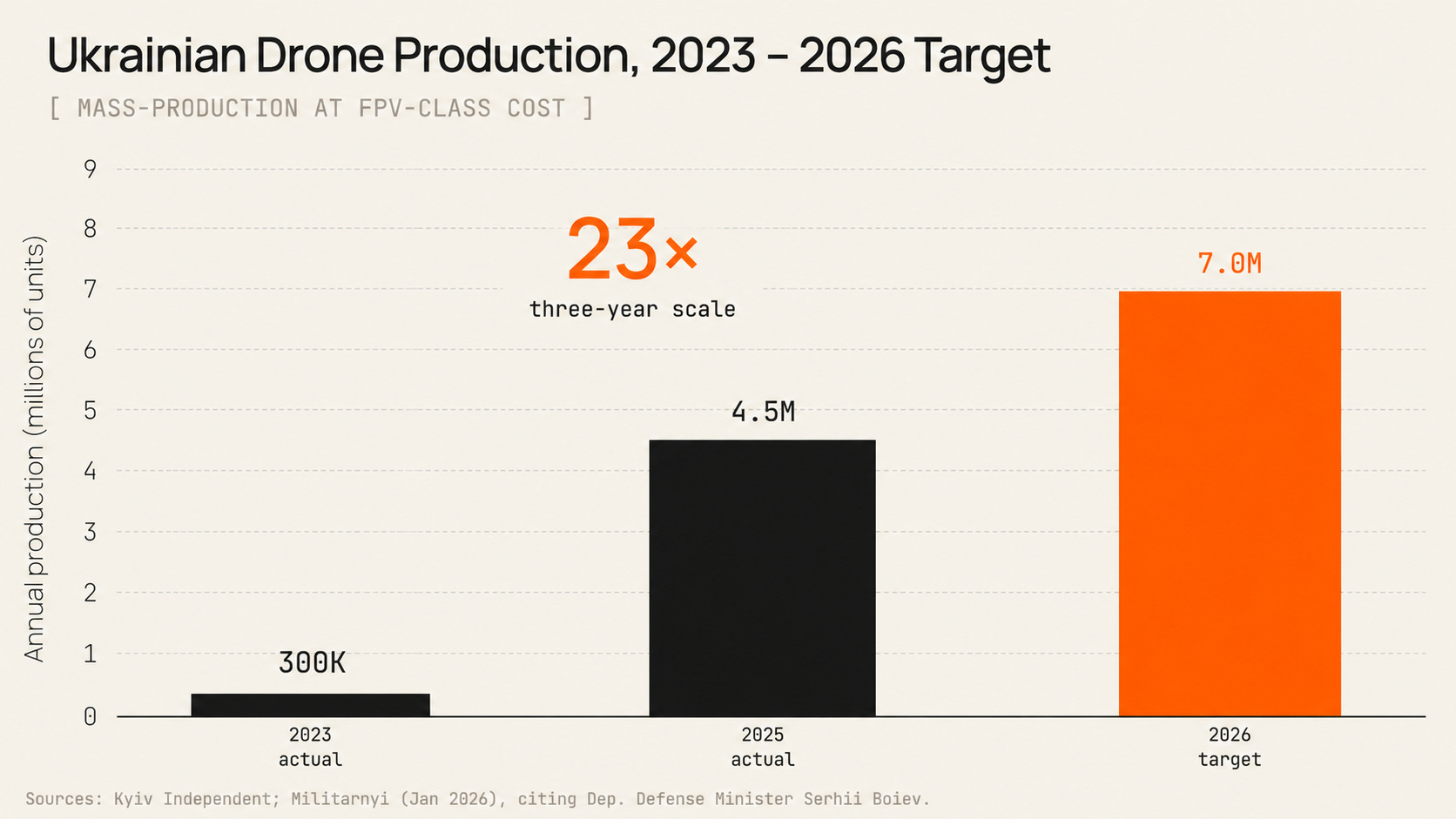
The mass-production model behind the surge. Sources: Kyiv Independent; Militarnyi (January 2026), citing Deputy Defense Minister Serhii Boiev.
The lesson across both theaters is the same one the last edition drew: mass production and affordable interception are now the center of gravity of modern conflict. The Middle East may be cooling, but the war in Europe keeps writing the doctrine, and Eurosatory 2026, the largest land-and-air defense exhibition ever staged, opened in Paris on June 15 with counter-drone systems as the dominant theme. The doctrine outlasts the truce.
Where the Market Is Pointed
Federal dollars concentrate in the fastest-compounding corners of the market, not the aggregate.
The contracts land on a counter-drone market that remains the industry’s fastest-compounding niche. MarketsandMarkets projects the counter-UAS market growing from roughly $6.6 billion in 2025 to $20.3 billion by 2030, near a 25 percent compound annual growth rate, with the United States holding the largest share. The broader drone market stays on its $69 billion to $148 billion trajectory from 2026 to 2036, per IDTechEx.
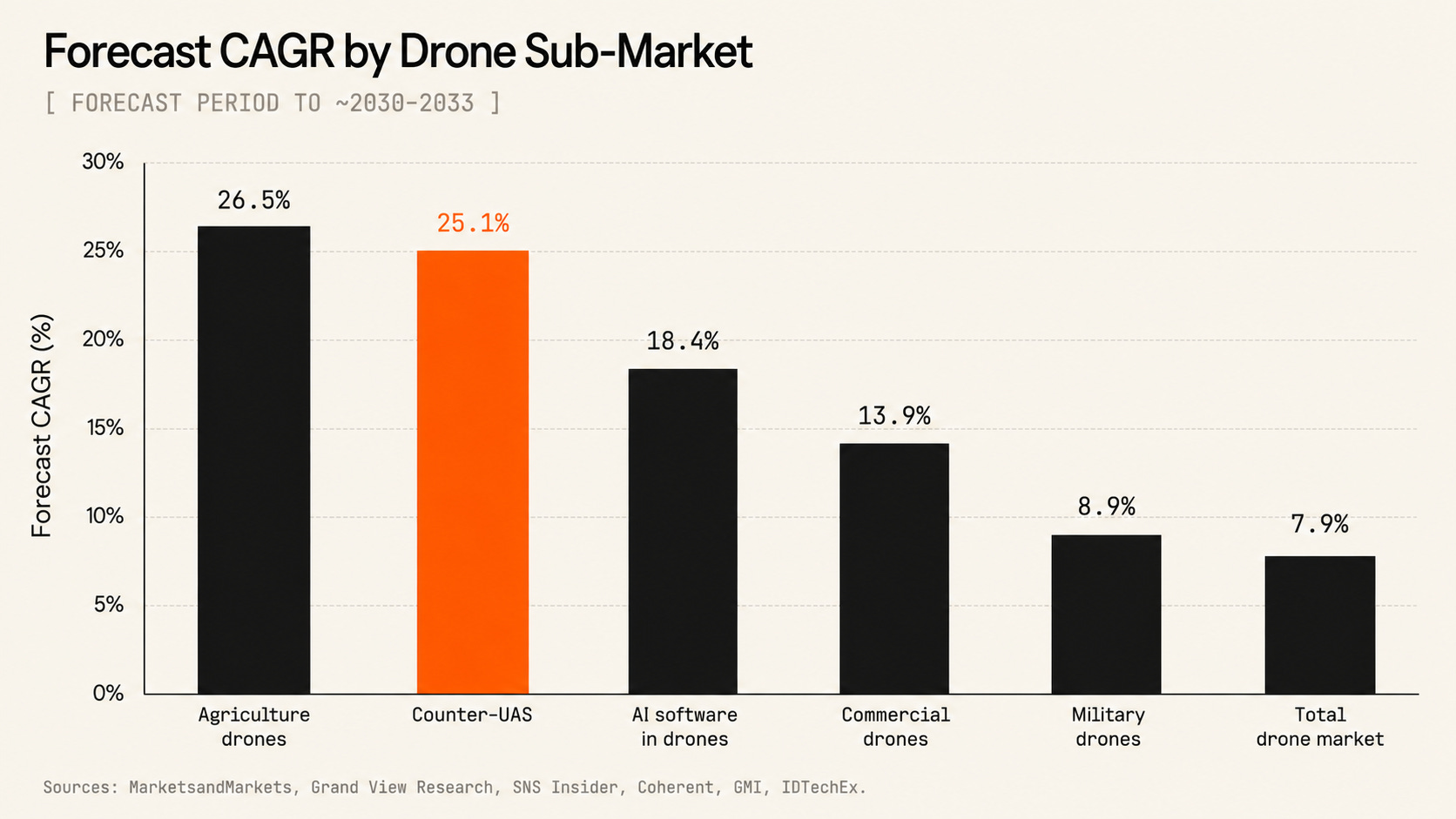
The high-growth corners outrun the aggregate, and that is where this period’s federal dollars are pointed. Sources: MarketsandMarkets, Grand View Research, SNS Insider, Coherent Market Insights, Global Market Insights, IDTechEx.
The aggregate number is not where the procurement action is. The federal dollars concentrate in counter-UAS, autonomy software, and the production capacity to field cheap mass at home. The market forecast and the new procurement rules point the same direction, toward domestic scale in the fastest-growing corners.
What to Watch (June 15 to 22)
Four near-term events. Each tests how fast the new structure can field what it is built to buy.
US-Iran memorandum signing on June 19. The framework is set to be formalized in Switzerland, with the Strait of Hormuz reopening and the blockade lifted. Watch whether the 60-day ceasefire holds and how counter-drone demand reads against a cooling Gulf.
Eurosatory 2026 runs through June 19 in Paris. The largest land and air defense show ever staged has counter-UAS front and center. Expect a wave of counter-drone partnerships, orders, and product launches, with the US Army expanding its drone and counter-drone marketplaces on June 16.
The NDAA moves toward the Senate floor. With the committee bill reported out, watch for floor scheduling and any amendments touching the new autonomous-systems command before the eventual House-Senate conference.
The contracting ban takes effect June 30. The bar on direct contracts with the 188 listed Chinese firms becomes active, the first hard test of how the rule reshapes supplier choices across the drone industrial base.
Each is measurable and near-term, and none depends on a single company. Together they describe how fast the United States can turn standing structure into fielded capability.
Bottom Line: The Surge Became an Institution
The story moved from what is ordered to what is permanent. Structure, not any one war, is now the demand signal.
This was the period the drone surge stopped depending on a headline. The Senate is building a four-star command with its own acquisition authority inside a $1.14 trillion bill, the money keeps flowing through awards like the P550 and approvals like SkyValor, and the ban on 188 Chinese firms hardens the case for domestic and allied production. The war on Iran appears to be winding down through a fragile framework, and that de-escalation changes nothing about the lesson both wars taught: cheap mass on offense, affordable interception on defense.
The constraint is the one structure cannot wish away. A command can be authorized, but capability still has to be manufactured, accepted, and sourced at home on a fixed timeline. The winners for the rest of the decade will be whoever can do all three at scale. The structure is now being built to buy from them. The open question is who can deliver.
A dedicated four-star buyer is meant to speed fielding. Does a command with its own checkbook actually shorten the path from contract to combat, or does it add one more headquarters between the warfighter and the drone? Reply with your read.
Powerus builds autonomous systems for defense, counter-UAS, agriculture, wildfire response, and maritime operations. Designed, manufactured, and assembled in the United States.