From Promise to Purchase Orders
The surge stopped being a forecast. In the span of a few days, the Pentagon confirmed it is taking delivery of attack drones, the House advanced a defense bill near one and a sixth of a trillion dollars, the United States and two allies turned an undersea-drone ambition into a signed program, and two live drone wars escalated on opposite sides of the world.

Powerus Signal · Week of June 8, 2026
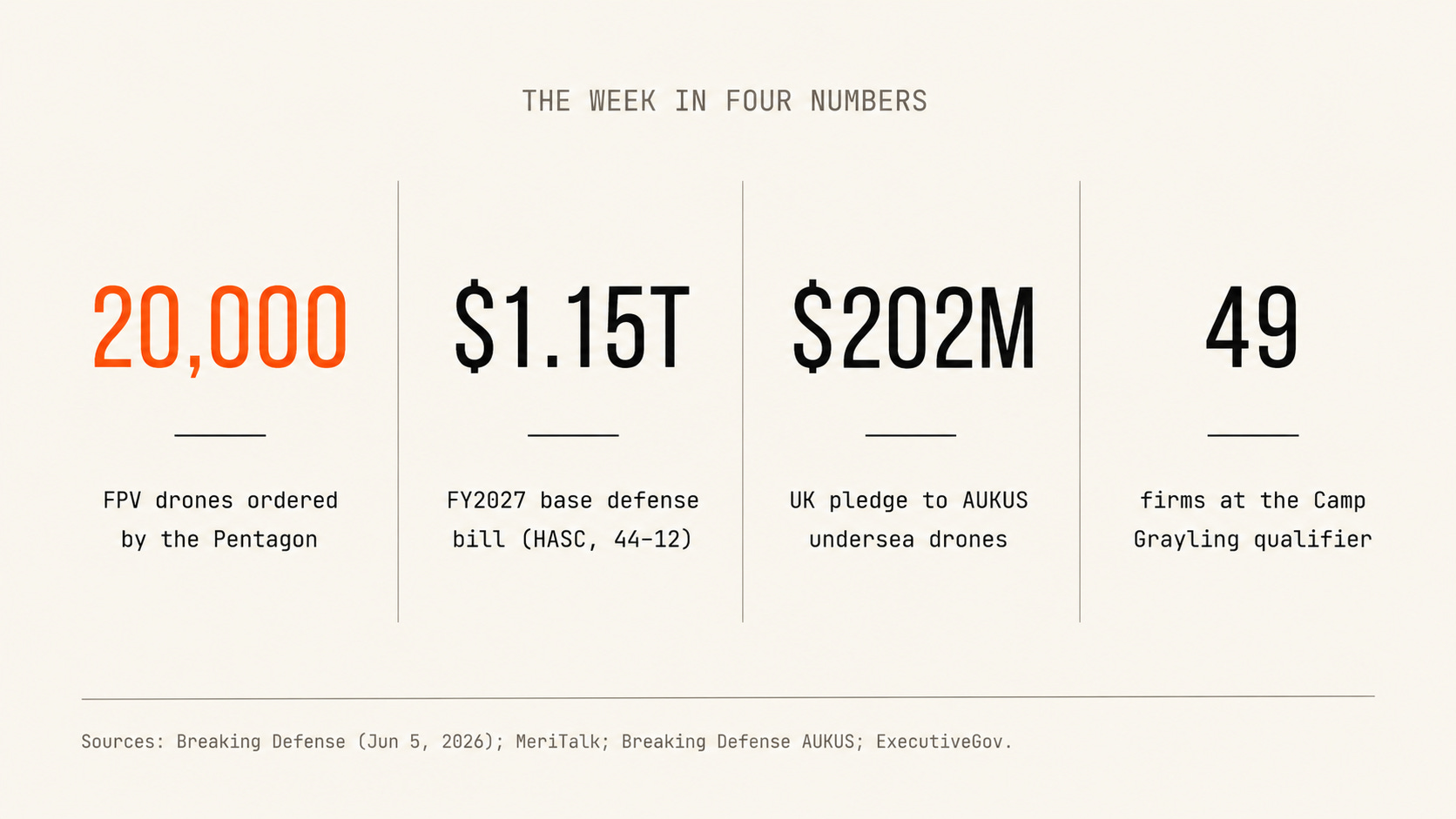
Sources: Pentagon’s 20,000-drone order (Breaking Defense, June 5, 2026); $1.15 trillion NDAA; £150 million UK commitment; Camp Grayling qualifier field.
The previous edition asked whether domestic drone defense would scale. The order book just answered. The open question now is who can deliver, not who can promise.
The surge stopped being a forecast. In the span of a few days, the Pentagon confirmed it is taking delivery of attack drones, the House advanced a defense bill near one and a sixth of a trillion dollars, the United States and two allies turned an undersea-drone ambition into a signed program, and two live drone wars escalated on opposite sides of the world.
The throughline is a shift from authorization to execution. A year of “drone dominance” language is now converting into purchase orders, acceptance tests, and committee votes. The catch is in the ratios: deliveries and formal acceptances are still small against the size of the orders. The companies that matter through the second half of 2026 are the ones that can manufacture and pass acceptance testing at volume, not the ones with the best prototype.
This briefing tracks what moved, why it is urgent, and the four near-term events that move the procurement-velocity question forward.
From Promise to Purchase Orders
The Pentagon is now accepting attack drones. The order book dwarfs what has actually been delivered.
The Defense Department confirmed it ordered 20,000 small first-person-view, one-way attack drones from 10 of the top 11 vendors out of the original Gauntlet I competition. The buy is roughly one billion dollars across two years, and about ten thousand units below earlier predictions. Deliveries have begun.
The acceptance numbers are the story. Neros leads delivery: it has shipped all 2,400 of its ordered Archer quadcopters, of which 1,040 have been formally accepted. The rest of the field has shipped a combined 560 units, all still awaiting acceptance.
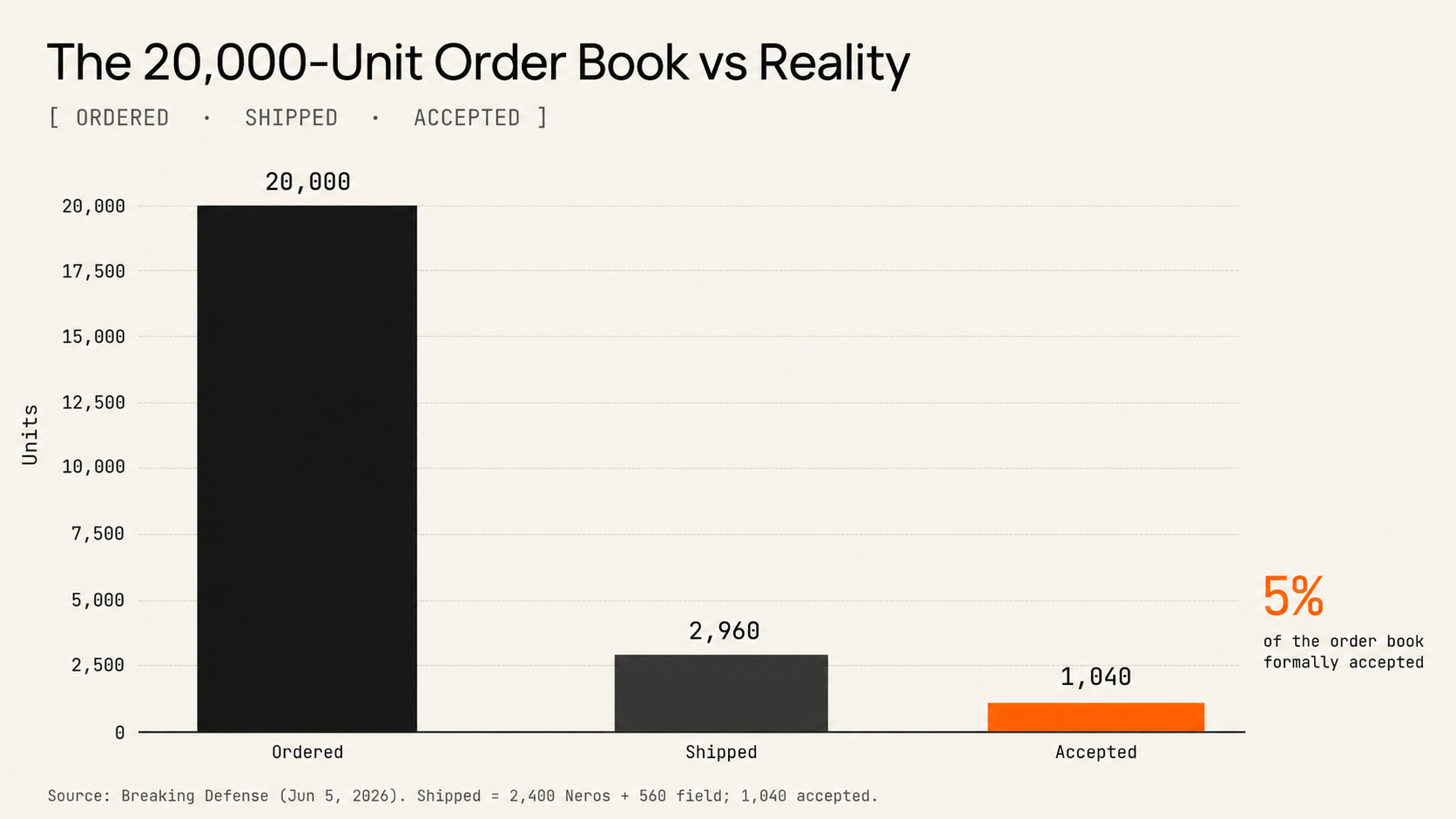
Roughly five percent of the order book is formally accepted. Source: Breaking Defense (June 5, 2026).
Two more procurement signals landed alongside the order. The Army awarded Griffon Aerospace a $68 million deal for Outlaw Gen 3 target and surrogate-threat drones tied to Operation Epic Fury, the United States campaign against Iran, due by the end of March 2027. And a Defense Innovation Unit competition named five lethality-challenge winners, Bravo Ordnance, Kela Defense, Kraken Kinetics, Mountain Horse, and Northrop Grumman, to supply payloads for Group 1 drones weighing twenty pounds or less.
Defense Secretary Pete Hegseth framed the intent in a directive to expand the drone industrial base and equip every squad with one-way attack drones by the end of fiscal 2026. His stated problem: United States units are not outfitted with the lethal small drones the modern battlefield requires.
What acceptance testing selects for is not the best demo. It is which companies can manufacture at scale and pass inspection on a fixed timeline. That is the same lesson the war in Ukraine has been teaching for two years.
The $1.15 Trillion Bill, and the Surge Riding Beside It
The base bill mirrors the request. The drone-heavy increases ride a separate reconciliation vote.
On June 4, the House Armed Services Committee advanced its fiscal 2027 defense authorization by a 44 to 12 vote after a fourteen-hour markup. The bill authorizes a topline of nearly $1.15 trillion that mirrors the administration’s base request, but it excludes the additional $350 billion in reconciliation spending. That separate track carries the largest drone and air-defense increases. The administration is seeking $1.5 trillion for defense in total.
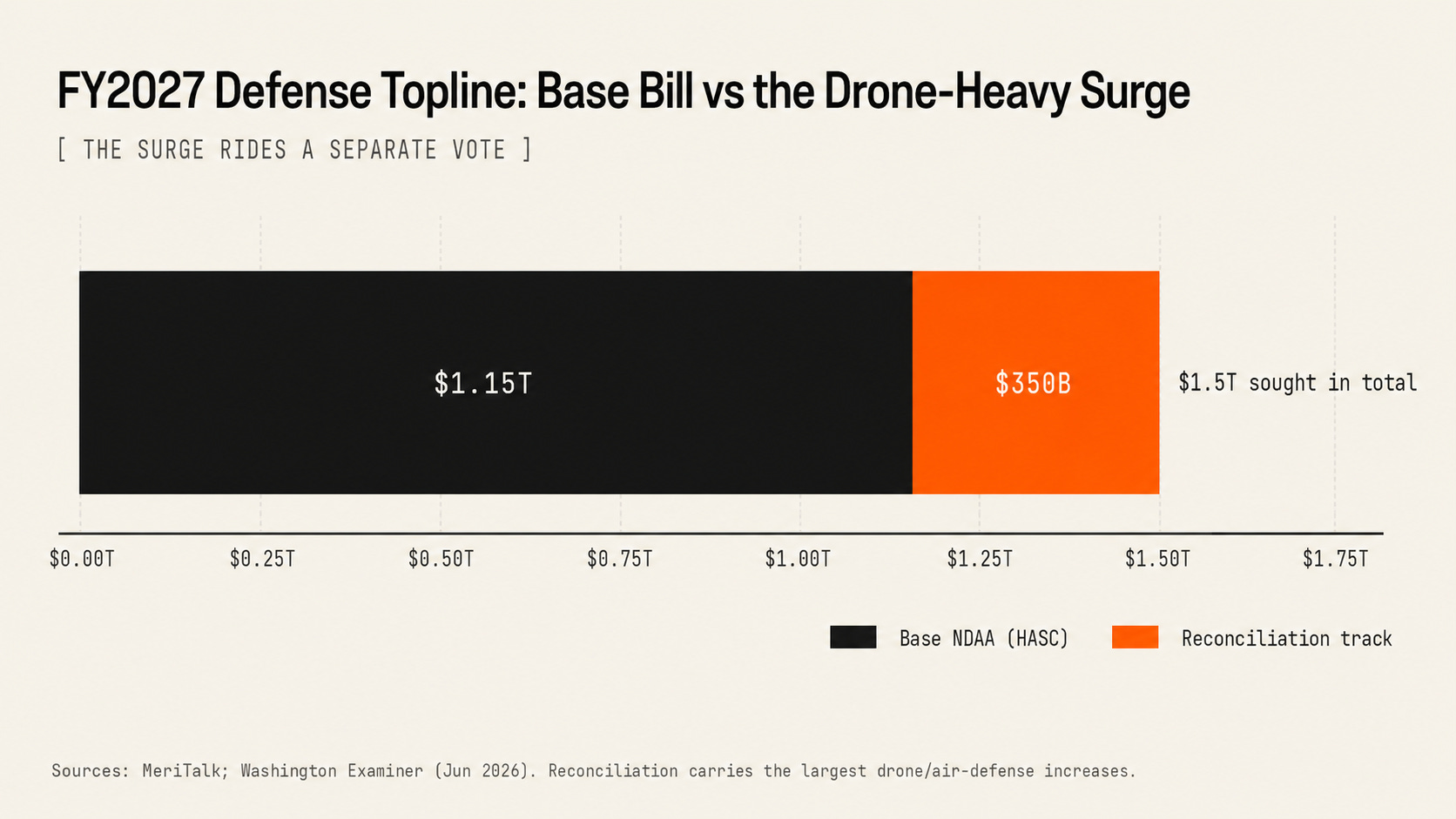
The base bill is authorized through the NDAA; the drone-heavy surge depends on a separate reconciliation vote. Sources: MeriTalk; Washington Examiner (June 2026).
For drone watchers, the bill reads as a mixed signal. It trimmed about $137 million from the Air Force’s Collaborative Combat Aircraft “wingman” research line. It built out AI governance with an AI incident-reporting program and protected-disclosure rules for fielded defense AI systems. The committee passed a bipartisan right-to-repair amendment giving the services access to the data and parts they need to fix their own equipment, a quiet win for sustainment-focused vendors. A separate amendment to rename the department the “Department of War“ passed 29 to 27.
The structural point sits underneath the line items. The money that funds the drone surge is not yet law. It rides a reconciliation vote that has its own timeline and its own politics, and contract velocity through the rest of 2026 tracks that vote, not the base bill.
AUKUS Crosses Into the Maritime Domain
Allied autonomy investment moved from the air domain into the water on May 30. The deliverable is the signal.
On May 30, on the sidelines of the IISS Shangri-La Dialogue in Singapore, the United States, the United Kingdom, and Australia formally launched the first signature project under AUKUS Pillar Two: a trilateral effort to build interchangeable payloads and enabling systems for unmanned underwater vehicles. First deliveries are targeted for 2027.
The United Kingdom committed roughly £150 million, about $202 million. The program does not build the vehicles. It develops the payloads that drop into any allied undersea fleet:
Sensors for undersea surveillance and seabed infrastructure protection.
Navigation and communications for coordinated operations.
Weapons, including mines and torpedoes, used only under human control.
Common standards feeding platforms like Anduril’s Ghost Shark and C2 Robotics’ Speartooth.
Allied autonomy investment has crossed from the air domain into the maritime domain. A large adjacency opens for any company whose autonomy stack carries across air and sea.
Swarming Becomes the Next Procurement Frontier
Single platforms are the current contest. Coordination software across many platforms is the next one.
The acceptance tests and qualifiers measure individual airframes. The next layer of the competition is the software that makes many airframes act as one. On June 3, Powerus signed a memorandum of understanding with Swarmer to explore integrating Swarmer’s vendor-agnostic coordination software across its air and maritime autonomous systems, aimed at defense, counter-drone, border security, and critical-infrastructure missions. The agreement is exploratory and non-binding, with no production or financial commitment.
The reason this category matters is operational, not corporate. A single operator coordinating hundreds of low-cost drones changes the math of both offense and defense. It is the difference between buying drones and fielding a system. The vendors who win the next phase will be the ones whose hardware and whose coordination layer interoperate, because the buyer increasingly wants both in one architecture.
Why It Is Urgent: Two Live Drone Wars
The buildout has a live justification on two fronts. Both point at the same thesis.
The procurement urgency is not theoretical. Two simultaneous drone wars are running, and both make the same argument: cheap mass on offense, affordable interception on defense.
In the Middle East, the fragile United States and Iran ceasefire frayed badly. On June 3, an Iranian drone struck Terminal 1 of Kuwait International Airport, killing one person and injuring dozens. After Iran targeted commercial shipping near Larak Island, CENTCOM shot down six Iranian attack drones over two days threatening traffic in the Strait of Hormuz, and United States forces struck Iranian coastal radar sites on Qeshm Island and at Goruk in Hormozgan Province. Iran answered with a salvo of ballistic missiles at Bahrain and Kuwait. The war on Iran reached the 100-day mark on June 8 with no end in sight, and a weekend Hezbollah drone attack in southern Lebanon wounded four Israeli reservists. Secretary of State Marco Rubio named the core problem in June 2 testimony: the United States is still using expensive interceptors to knock down cheap drones, and “that needs to change.”
The other front escalated just as sharply. On June 6, timed to the final day of Russia’s St. Petersburg economic forum, Ukraine launched its largest drone attack of the war: hundreds of drones reaching roughly 1,000 km into Russia, hitting the Kronstadt naval base and the Navy’s 15th Arsenal and setting an oil depot ablaze in Krasnodar Krai. Russia said it downed 376 drones overnight, more than 140 over the Leningrad region alone. Russia retaliated. On June 7, a Russian drone struck the spent-nuclear-fuel storage facility in the Chornobyl Exclusion Zone, where no fuel was stored in the damaged building, and an overnight barrage of 236 drones killed civilians across southern Ukraine.
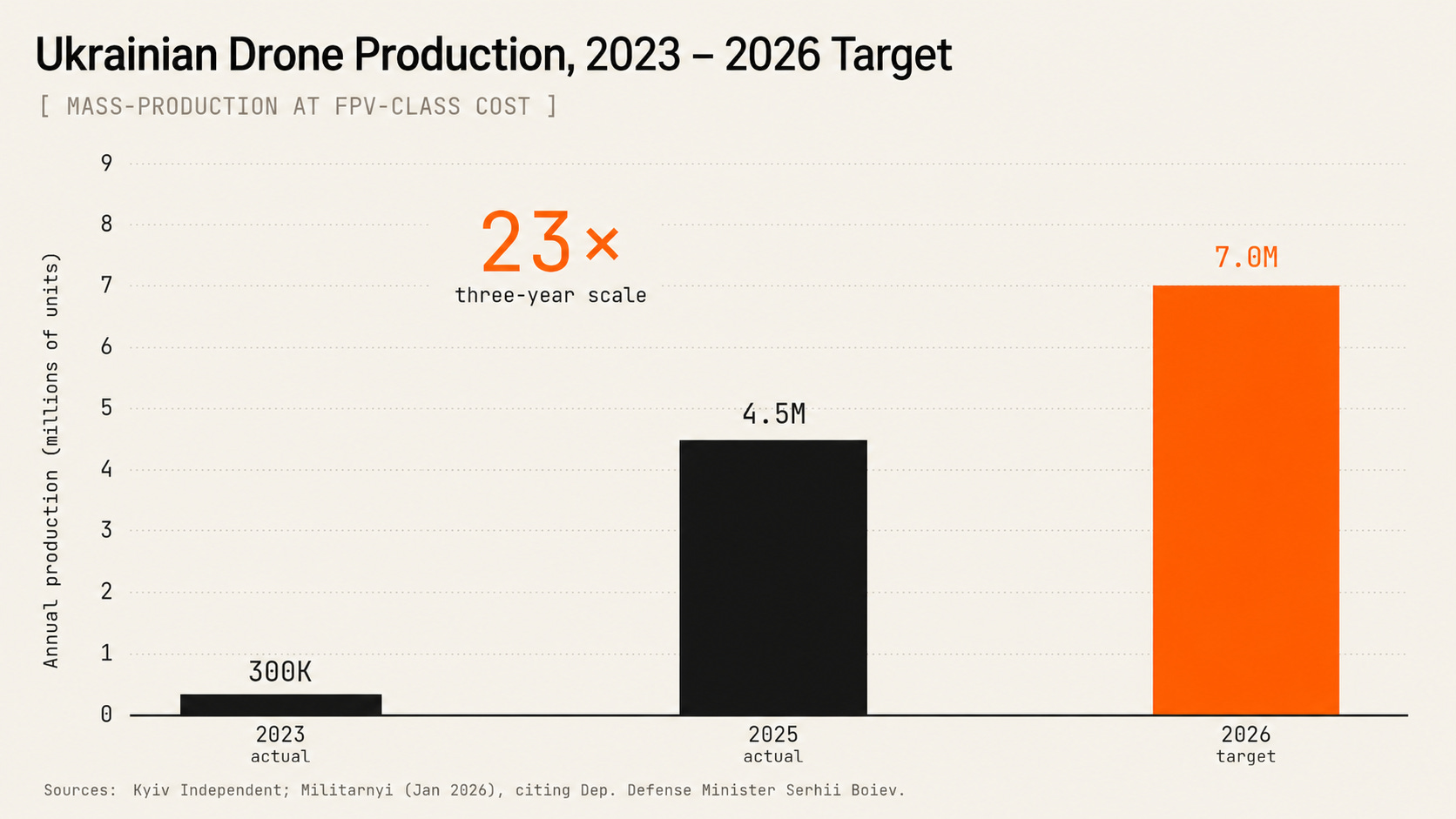
The mass-production model behind the surge. Sources: Kyiv Independent; Militarnyi (January 2026), citing Deputy Defense Minister Serhii Boiev.
The strategic logic has not changed since the previous edition. Ukraine’s mass-production model, targeting more than 7 million drones in 2026, rewrote procurement thinking worldwide. What is different is that with two drone wars running at once, the threat is immediate for United States forces, not a projection.
The Money Behind the Headlines
Federal dollars are pointed at the fastest-compounding corners of the market, not the aggregate.
The contracts land on a counter-drone market that remains the industry’s fastest-compounding niche. MarketsandMarkets projects the counter-UAS market growing from roughly $6.6 billion in 2025 to $20.3 billion by 2030, near a twenty-five percent compound annual growth rate, with the United States holding the largest share. The broader drone market stays on its $69 billion to $148 billion trajectory from 2026 to 2036 per IDTechEx.
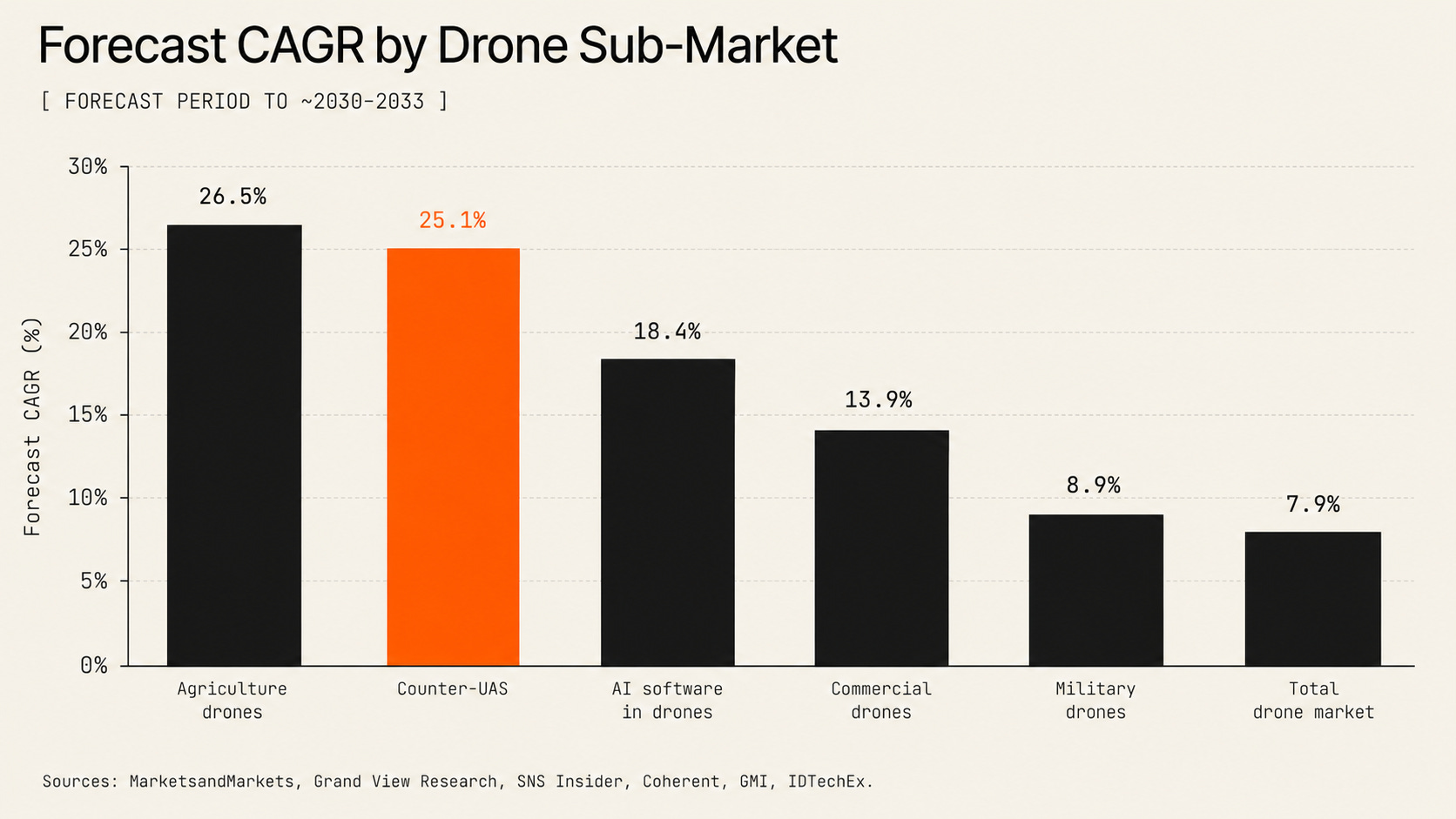
The high-growth corners outrun the aggregate, and that is where this period’s federal dollars are pointed. Sources: MarketsandMarkets, Grand View Research, SNS Insider, Coherent Market Insights, Global Market Insights, IDTechEx.
The aggregate number is not where the procurement action is. The federal dollars are concentrated in counter-UAS, autonomy software, and the production capacity to field cheap mass. The market chart and the contract flow point the same direction.
What to Watch: June 8 to 15
Four near-term events. Each one moves the procurement-velocity question forward.
Senate takes up its defense bill. The Senate Armed Services Committee holds an open full-committee markup on June 10 and a closed session on June 11 for the classified annex. This is the next gate for the fiscal 2027 bill and any Senate-side drone and counter-UAS provisions.
Camp Grayling qualifier momentum. The Phase II qualifier of 49 firms across 79 drone designs runs through this summer. Watch for early heat results, additional acceptances on the 20,000-unit order, or new framing on the Gauntlet II production round expected to begin late 2026.
Reconciliation timeline. Any movement on the separate $350 billion reconciliation track is the single biggest variable for drone-contract velocity through the second half of 2026. The base bill is not where the surge lives.
Iran escalation risk. With drones and missiles still flying around the Strait of Hormuz, further strikes or interceptor expenditures would reinforce the low-cost-defense case and could move the whole counter-UAS complex.
Each is measurable and near-term. None depends on a single program or company. Together they describe how fast the United States procurement system can move from authorization to fielded capability.
Bottom Line: Authorization Became Execution
The story moved from what is authorized to what is accepted. The acceptance ratio is the number to watch.
The shift this period is from authorization to execution. Orders are real at 20,000 units. Money is moving through a $1.15 trillion bill plus a separate $350 billion push. The maritime domain is now in play through AUKUS. The threat is active on two fronts, with the war on Iran at the 100-day mark and Ukraine and Russia trading their deepest strikes of the war.
The constraint is the same one acceptance testing exposes. Deliveries and formal acceptances are still small against the orders. The winners through the rest of the decade will be whoever converts orders into accepted units at scale. That ratio, not the order book, is the number that decides who is building the procurement architecture and who is just bidding on it.
The order book says 20,000. Formal acceptances say 1,040. Which closes the gap first: a single vendor scaling acceptance, or the Senate moving the reconciliation track? Reply with your read.
Powerus builds autonomous systems for defense, counter-UAS, agriculture, wildfire response, and maritime operations. Designed, manufactured, and assembled in the United States.