The Swing Variable Is a Drone
The last edition tracked the defense buildout going physical: parts financed, the first program units shipped, a domestic component base taking shape. This week a live war put that same buildout to the test, and it held.

Powerus Signal · Week of June 29, 2026
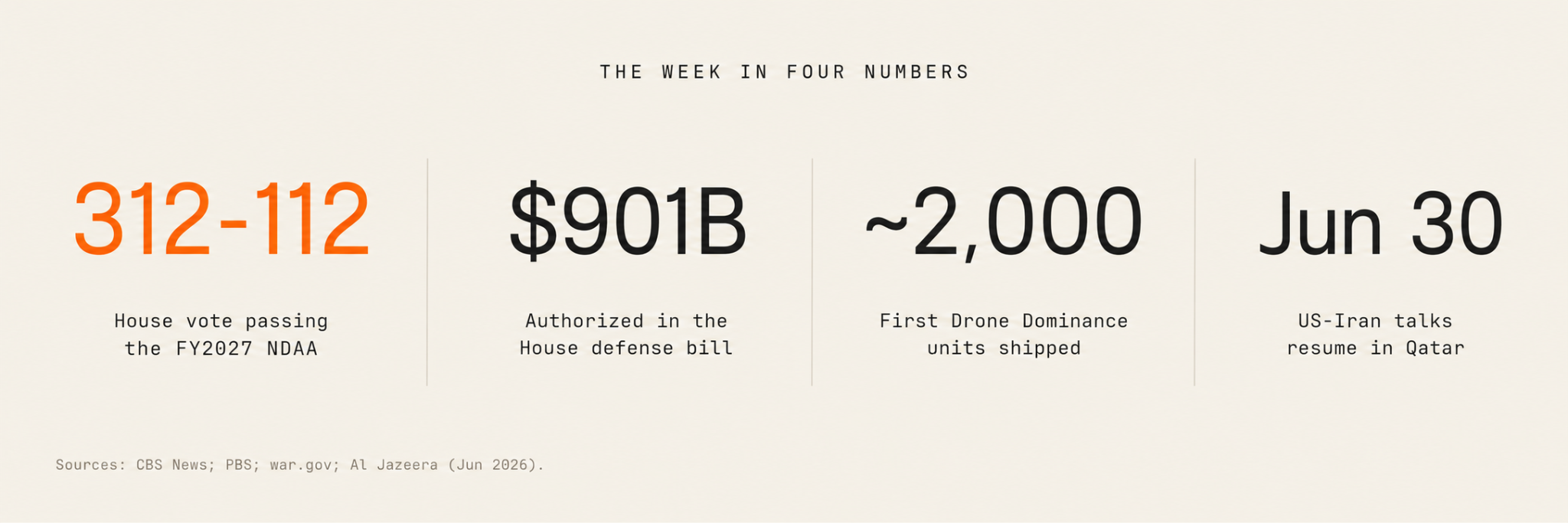
Sources: House passes the NDAA 312 to 112 (CBS News, June 2026); troop pay and weapons overhaul (PBS); first units shipped (Department of War); talks resume in Qatar (Al Jazeera).
A single cheap one-way drone on a tanker nearly unwound an eleven-day-old ceasefire in seventy-two hours. That is the clearest case yet that affordable autonomy has become the swing variable in great-power crisis management, and it is the exact demand the buildout is being built to answer.
The last edition tracked the defense buildout going physical: parts financed, the first program units shipped, a domestic component base taking shape. This week a live war put that same buildout to the test, and it held. The Gulf ceasefire signed in mid-June was stressed almost to breaking: a tanker strike near the Strait of Hormuz drew US retaliation and Iranian missiles on two US bases, and then both sides stepped back inside three days.
Underneath the volatility, the structural trend never paused. The House passed a roughly $901 billion defense bill and sent it to the Senate. The Pentagon accepted and shipped the first units under its flagship drone program and lined up a far larger order for the fall. A US component maker kept widening a domestic parts base. The geopolitics is the noise. The industrial base is the signal, and the signal is still pointing up.
This briefing covers the seventy-two-hour Gulf scare, the defense bill clearing the House, the first program drones coming off the line, the deep-strike war that keeps writing the doctrine, and the parts base quietly hardening underneath all of it.
The Gulf Truce Bends and Holds
A tanker strike, US retaliation, and missiles on two US bases tested the new ceasefire to its limit, then both sides stepped back to the table.
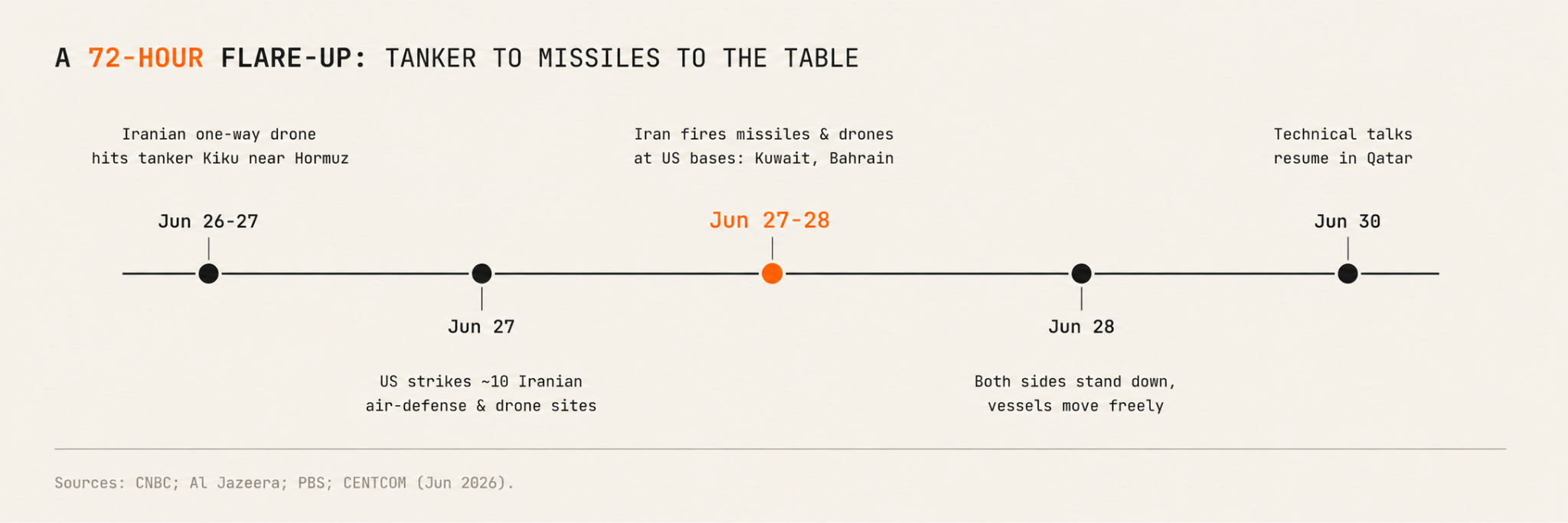
The defining story of the period was the near-collapse, and rescue, of the US-Iran peace deal. An Iranian one-way drone struck the Panama-flagged tanker Kiku near the Strait of Hormuz, a Greek-owned vessel carrying more than two million barrels of crude. US Central Command answered with strikes on roughly ten Iranian targets, including air-defense sites, communications, and drone-storage facilities. Iran’s Revolutionary Guard then fired missiles and drones at US bases in Kuwait and Bahrain, with Kuwait reporting two intercepted ballistic missiles and Bahrain a damaged residential building.
Then the de-escalation. Both sides agreed to halt hostilities, let vessels move freely, and continue technical talks on the fourteen-point framework, with negotiations set to resume in Qatar on June 30.
The deal bent but did not break. Sources: CNBC; Al Jazeera; PBS; US Central Command (June 2026).
The episode cuts both ways for the buildout. A signed ceasefire trims the structural Gulf threat that has justified much of the counter-drone urgency. But the same week proved the underlying problem in the sharpest terms yet: one inexpensive drone on one tanker moved oil markets and rattled great-power relations inside a single news cycle. Ceasefire durability is now the dominant short-term swing factor for defense sentiment, and the medium-term case for affordable interception only strengthened.
Volatility is the headline. The industrial base is the trend. A truce can cool a threat in a day, but it cannot un-teach the lesson the fighting wrote, and the demand for affordable interception outlasts any single deal.
The Defense Bill Clears the House
The House passed its $901 billion authorization with landmark acquisition reform, sending the fight to a Senate that wants more.
On June 24 the House passed the FY2027 National Defense Authorization Act, HR 8800, by a vote of 312 to 112, authorizing roughly $901 billion. The bill carries a 3.8 percent troop pay raise, a package of acquisition reforms meant to speed Pentagon weapons buying, a floor of at least 76,000 troops in Europe and 28,500 in South Korea, and $400 million a year for two years to manufacture weapons for Ukraine.
Two chambers, one bill. Sources: CBS News; PBS (House figures); Senate Armed Services Committee FY2027 NDAA.
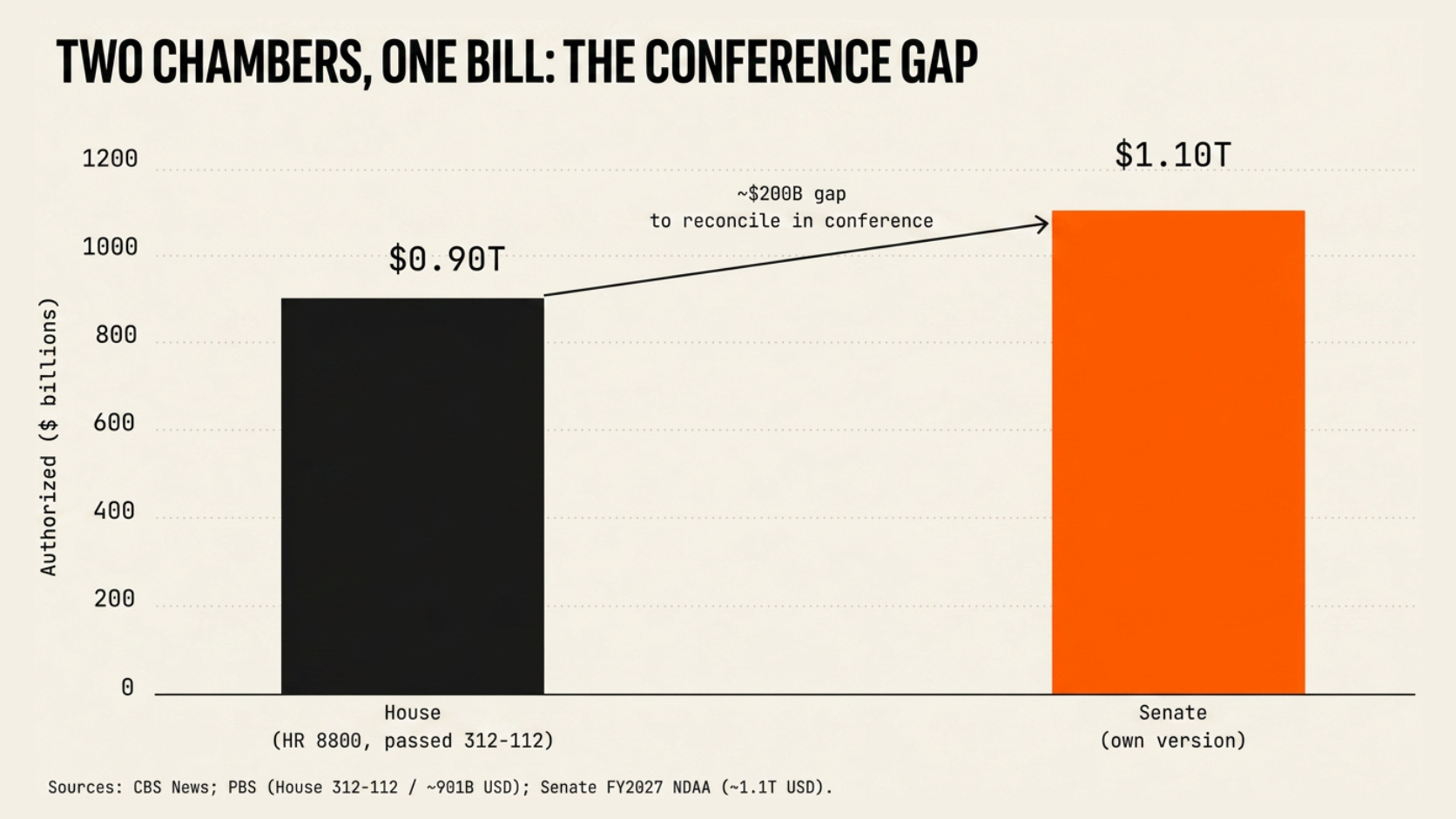
The vote matters because of where it sits in the process. An authorization that clears the House floor is a different object than a committee markup, which is where the last edition found this same bill. It now heads to a Senate whose own version authorizes about $1.1 trillion, setting up a conference to reconcile the two before the August recess. The gap between the chambers is real money, but the direction is not in dispute. Both bills point at the same priority: buy modern capability faster, and buy more of it.
The First Program Drones Come Off the Line
The Pentagon accepted and shipped its first flagship drones, then teed up an order twenty times larger and a qualifier that raises the manufacturing bar again.
The Defense Innovation Unit confirmed the Department of War accepted its first batch of aircraft under the Drone Dominance program and shipped nearly 2,000 units to the services. Phase I has purchased 30,000 drones, with an order for 60,000 more slated for September, described by the program’s deputy director as competitively awarded and tied to moving supply chains onshore. The two-year, roughly $1.1 billion effort aims to drive unit cost from about $5,000 toward $3,000 and field more than 200,000 AI-enabled drones by 2027.
Cost down, volume up, on a domestic line. Sources: Department of War; Defense Innovation Unit.
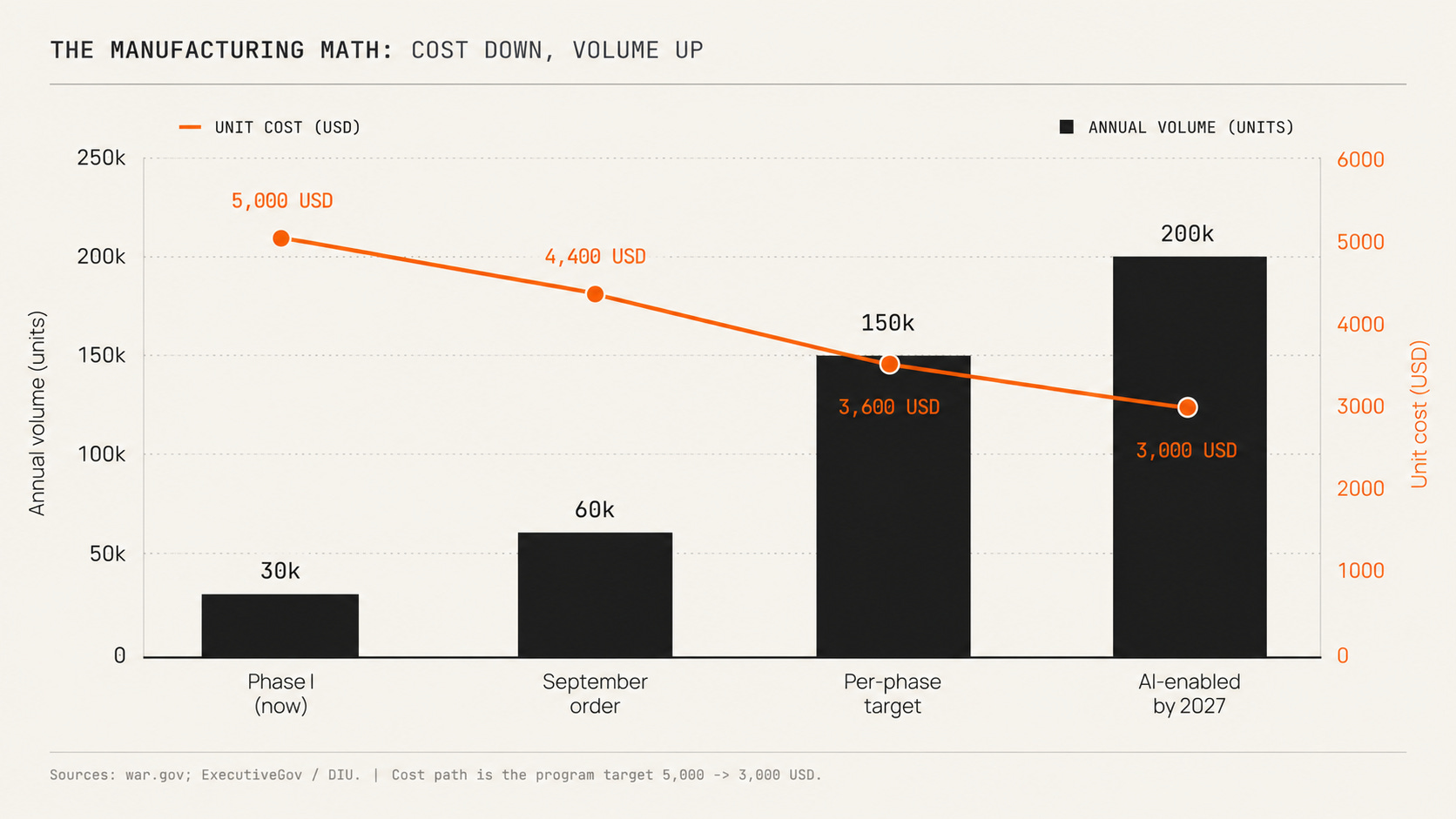
Acceptance is the moment a program stops being a budget line and becomes a transaction. A unit built, accepted, and shipped to a service is an order that already cleared. Driving cost toward $3,000 while pushing annual volume past 200,000 is a manufacturing problem before it is a technology problem, and the advantage moves to whoever can hold cost and quality at that volume.
The next round raises the bar again. Gauntlet II, the program’s next qualifier, begins later this summer and adds night and urban operations while requiring each entrant to field 120 drones to qualify. That 120-unit entry requirement is the quiet filter. A company that can hand-build a winning prototype is not the same as a company that can put 120 qualified units on a range, and the gap between the two is exactly the production capacity the program is trying to surface.
The Other War Keeps Writing the Doctrine
Ukrainian deep strikes reached a Siberian refinery and knocked out a fifth of Russian refining, turning mass autonomy into an economy-wide weapon.
The eastern front showed no pause. Overnight into June 28, Ukraine struck two Russian oil refineries, the Slavyansk-na-Kubani plant in the Krasnodar region and a refinery in Yaroslavl roughly 700 km from the border. Days earlier its forces reached far deeper, hitting a refinery in Tyumen in western Siberia more than 2,000 km away, with Kyiv saying it has now developed drones with a range beyond 3,000 km.
Long-range one-way drones put refineries inside the fight. Sources: Kyiv Independent; PBS; South China Morning Post; UNN. Reach is approximate.
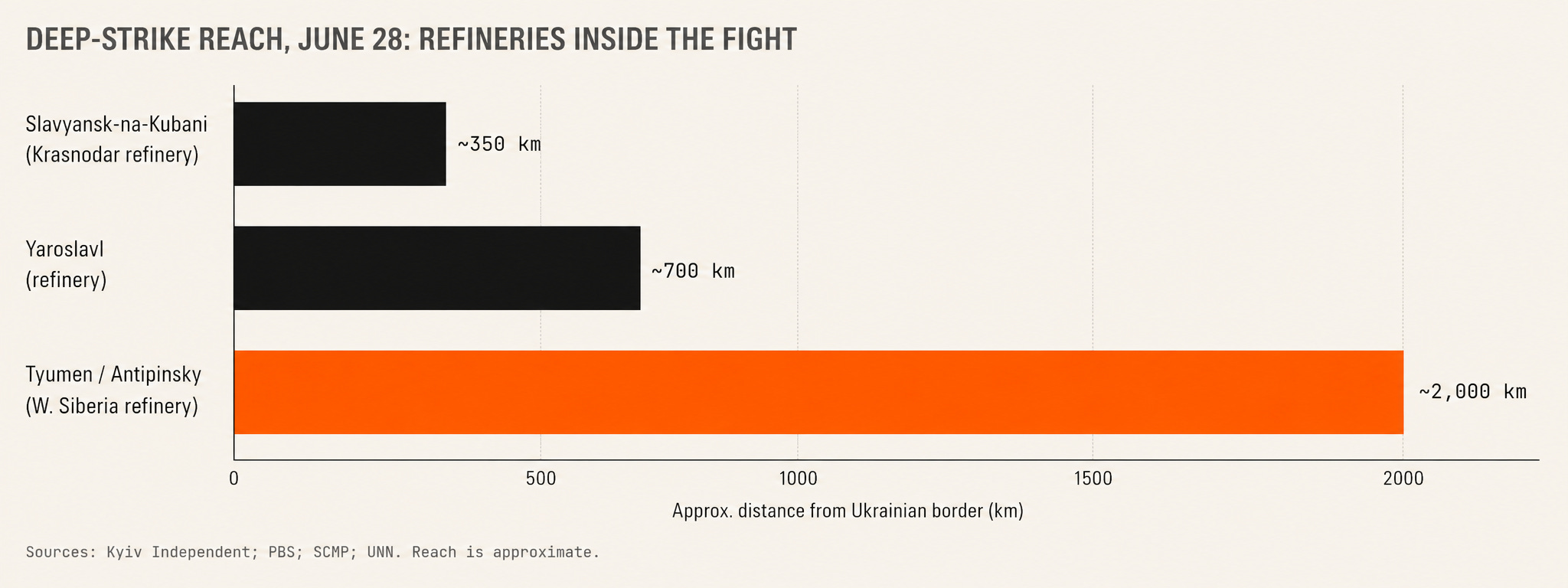
The cumulative effect is strategic, not symbolic. More than two dozen strikes since March have hit eight of Russia’s ten largest refineries, and analysts now estimate that more than 20 percent of the country’s refining capacity is offline, driving the worst nationwide fuel shortages in years. The doctrine being written in the east is the same one the Pentagon is buying against: mass-produced autonomy as a strategic, economy-wide instrument, answered by affordable interception at home.
A drone built for a few thousand dollars now reaches more than 2,000 km to take a fifth of a rival’s refining offline. That is no longer a battlefield tactic. It is an economic weapon, and it is the doctrine every defense buyer in the world is now pricing in.
The Parts Base Keeps Widening
A US component maker expanded its domestic battery footprint and pressed ahead on a $52 million acquisition, hardening the all-American supply chain underneath the headlines.
The quiet corporate story of the period was supply-chain depth. Unusual Machines, a US, NDAA-compliant maker of drone components, signed a lease for roughly 14,000 square feet of manufacturing space in Orlando on June 25 to support its battery business, and continued toward a $52 million acquisition of Upgrade Energy, a US maker of battery and power systems for unmanned aircraft, expected to close by mid-third-quarter. The same company put $30 million into domestic manufacturer Powerus earlier in June, one example of capital wiring an American parts base into place as the procurement rules turn against foreign-made hardware.
For domestic manufacturers, the read is structural. The contracting ban on listed Chinese suppliers that took effect June 30 narrows the field to vendors who can prove a clean parts trail, and the capital is following the rule. A stronger battery and component base is the kind of compounding that does not make a headline in a week of missiles and tankers, but it is the part of the buildout that decides who can actually field at scale.
What to Watch (June 29 to July 6)
Four near-term events. Each tests whether the trend can hold its line through the volatility.
The Qatar talks and ceasefire durability. US-Iran technical talks on the fourteen-point framework resume June 30 in Qatar. After the June 26 to 28 flare-up, watch whether the standdown holds, whether Hormuz stays open to traffic, and any movement on the nuclear track. This is the single biggest swing factor for defense and oil sentiment.
The NDAA moves to the Senate. With the House having passed HR 8800, watch for Senate floor action on its roughly $1.1 trillion version and the start of a House-Senate conference to reconcile the two bills before the August recess.
Gauntlet II and the September order. Watch for the formal start of Gauntlet II, with its night and urban requirements at 120 drones per entrant, and any detail on the 60,000-unit September buy. Both decide which US manufacturers scale into the next phase.
Supply-chain milestones. Watch for the Unusual Machines acquisition of Upgrade Energy to close by mid-third-quarter, and for any further domestic-sourcing moves as the contracting ban on listed Chinese firms beds in.
Each is measurable and near-term, and none depends on a single company. Together they describe how steadily the United States can turn a domestic supply base into fielded capability while the geopolitics swings around it.
Bottom Line: Noise on Top, Trend Underneath
The week’s drama was the volatility. The defense bill, the first program drones, and the parts base were the trend, and the trend kept compounding.
This was the period the new order got stress-tested and mostly held. The Gulf ceasefire survived a seventy-two-hour scare and went back to the table in Qatar. The House passed a $901 billion defense bill with landmark acquisition reform. The Pentagon shipped its first program drones and lined up 60,000 more. The all-American parts base kept widening. The risks are concrete, a fragile Gulf truce above all, but the direction is not in question.
Both wars keep teaching one lesson in two languages: cheap autonomy on offense, affordable interception on defense, and the side that can manufacture at volume from a domestic base wins the exchange. The constraint is the one a purchase order cannot solve on its own. The units still have to be built, accepted, and sourced from parts that clear the rule, on a fixed timeline, through whatever the geopolitics throws at the calendar. The winners for the rest of the decade will be whoever can do all of that at scale and survive the volatility.
If a single cheap drone can swing a great-power crisis in seventy-two hours, does that accelerate counter-drone procurement, or does it raise the political risk premium on every deployment and slow the buying down? Reply with your read.
Powerus builds autonomous systems for defense, counter-UAS, agriculture, wildfire response, and maritime operations. Designed, manufactured, and assembled in the United States.